The Lockerbie Bombing: What Happened, and Why a New Trial Starts in 2027
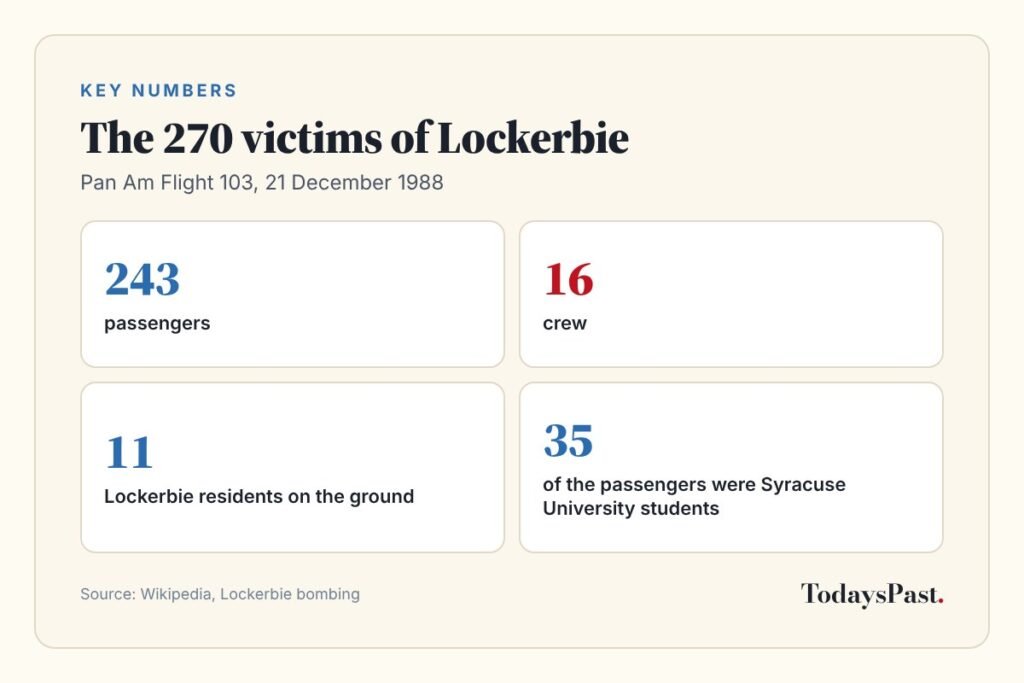
Just after 7pm on 21 December 1988, Pan Am Flight 103 was flying over the small Scottish town of Lockerbie, on its way from London Heathrow to New York, when a bomb exploded in its cargo hold. The Boeing 747 broke apart at about 31,000 feet. All 259 people on board were killed, along with 11 residents of Lockerbie who died when wreckage fell on their homes. With 270 victims, it remains the deadliest terrorist attack in British history.
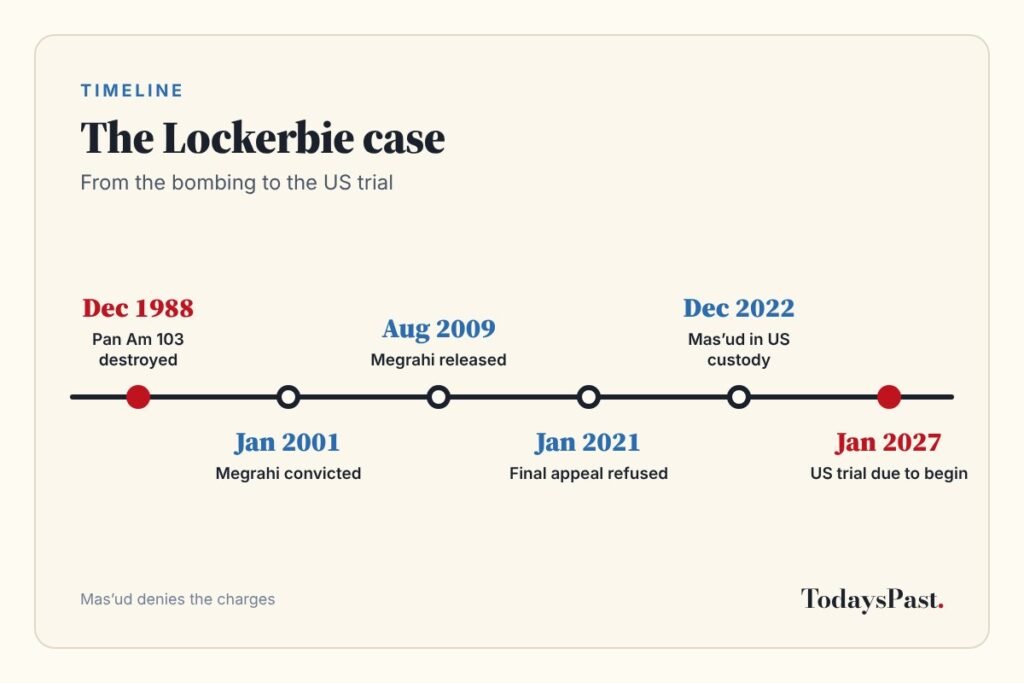
Nearly 38 years later, the case is still not closed. A second Libyan man, Abu Agila Mohammad Mas’ud, is due to go on trial in the United States in January 2027, accused of building the bomb. He denies the charges. This is what happened that night, what the courts have decided since, and what the new trial is about.

What happened on 21 December 1988?
Pan Am Flight 103 had started its journey in Frankfurt. It changed aircraft at Heathrow, where passengers boarded the Clipper Maid of the Seas for New York, with a final stop planned in Detroit. Many of those on board were heading home for Christmas (Wikipedia).
About 38 minutes after take-off, as the plane crossed southern Scotland, a bomb in the forward cargo hold exploded. The aircraft broke up in the air. The nose section landed in a field at Tundergarth, a few miles east of the town. The main section of the fuselage, with both wings and their fuel, came down on Sherwood Crescent in Lockerbie and exploded, destroying homes and leaving a crater about 47 metres long.
Of the 243 passengers, 190 were American, including 35 students from Syracuse University returning from a semester abroad. There were also 43 British victims, among them the 11 people killed on the ground in Lockerbie, and people from 21 countries in all.
How was the bomb hidden?
Investigators concluded that the bomb was hidden inside a Toshiba radio cassette player, packed into a brown Samsonite suitcase. A timer fragment, later identified as part of an MST-13 device, became one of the key pieces of evidence. Clothing in the suitcase was traced to a shop in Malta, which led investigators to the theory that the bag began its journey on a flight from Malta as unaccompanied luggage.
It became the UK’s largest criminal inquiry, led by Dumfries and Galloway Constabulary, at the time the smallest police force in Britain. Police, soldiers and volunteers searched vast areas of countryside for wreckage, sometimes recovering fragments no bigger than a fingernail.
Who was convicted of the Lockerbie bombing?
In November 1991, Scotland and the United States charged two Libyan intelligence officers: Abdelbaset al-Megrahi and Lamin Khalifah Fhimah. Libya refused to hand them over for years, and the UN imposed sanctions. In April 1999, Libya finally surrendered the two men for trial under Scottish law at a specially created court at Camp Zeist in the Netherlands.
On 31 January 2001, three Scottish judges convicted Megrahi of 270 counts of murder and sentenced him to life imprisonment. Fhimah was acquitted. Megrahi’s first appeal was rejected in March 2002 (Wikipedia).
Megrahi always denied involvement. In 2007, the Scottish Criminal Cases Review Commission referred his case back to the appeal court, saying there may have been a miscarriage of justice. He dropped that appeal in 2009, shortly before he was released on compassionate grounds because he had terminal prostate cancer. He returned to Libya, where he died in May 2012. His release angered many victims’ families, particularly in the United States.
Was Megrahi innocent?
This is still debated. Megrahi’s family, and some relatives of the British victims, have long argued that he was wrongly convicted. Critics have questioned evidence including the identification by a Maltese shopkeeper who sold the clothing found with the bomb.
However, the courts have upheld the conviction every time it has been tested. In 2020, the Scottish Criminal Cases Review Commission referred the case back for a second time at the family’s request. On 15 January 2021, five judges at the High Court of Justiciary refused the posthumous appeal, rejecting arguments that the original verdict was unreasonable and that key evidence had been withheld from the defence (Judiciary of Scotland). Megrahi remains the only person convicted of the bombing.
Fhimah, who was acquitted in 2001, died in 2026, according to reports from Libya (STV News).
Did Libya accept responsibility?
In 2003, as part of a deal to end UN sanctions, Libya formally accepted responsibility for the actions of its officials and agreed to pay compensation to the victims’ families. It paid about $2.16 billion in total. Colonel Gaddafi always maintained he had not personally ordered the attack, although in 2011 his former justice minister claimed that he had (Wikipedia).
Who is Abu Agila Mas’ud?
Abu Agila Mohammad Mas’ud Kheir Al-Marimi, usually called Mas’ud or Masud, is a Libyan man now in his mid-seventies. US prosecutors allege he was a long-serving bomb-maker for Libya’s intelligence service, and that he built and primed the device that destroyed Flight 103. He is not accused of planning the attack, but of playing a key technical role (STV News).
The United States charged him on 21 December 2020, the 32nd anniversary of the bombing. He was taken into US custody in December 2022 and has pleaded not guilty to charges including destruction of an aircraft resulting in death. Under US law, he is presumed innocent unless proven guilty.
A central part of the prosecution case is a statement that prosecutors say Mas’ud gave to a Libyan investigator in 2012, in which he allegedly admitted his involvement. His lawyers argue that the statement was coerced. In August 2026, the judge ruled that it can be used as evidence at trial.
When is the Lockerbie trial in the US?
The trial has been delayed several times. A trial in May 2025 was postponed because of the huge volume of evidence, about 413,000 files. A date in April 2026 was abandoned, partly over Mas’ud’s health. The trial was finally due to start in late August 2026, but it was postponed days beforehand after defence lawyers asked for time to review newly disclosed evidence.
In October 2026, US District Judge Dabney Friedrich set jury selection for 19 January 2027 at the federal court in Washington DC (Reuters via The Star). If it goes ahead, it will be the first US trial over the Lockerbie bombing, more than 38 years after the attack.
How Lockerbie remembers
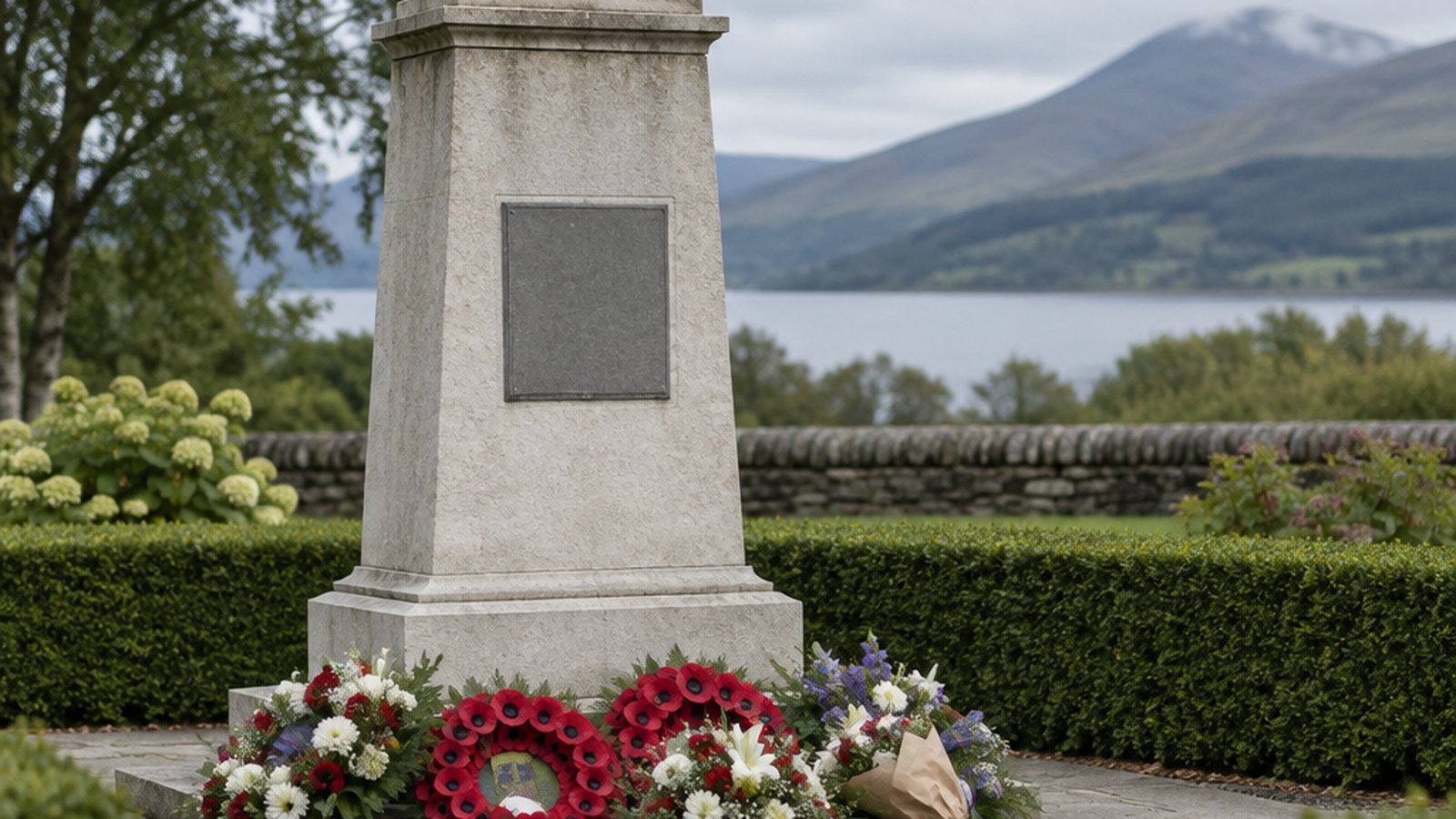
Every year on 21 December, services are held in Lockerbie and in the United States. The main memorial garden in Scotland is at Dryfesdale Cemetery, where the names of all 270 victims are recorded. There is also a memorial garden at Sherwood Crescent, where homes were destroyed. In the US, a memorial cairn was dedicated at Arlington National Cemetery in 1995, and Syracuse University holds a remembrance service at 2.03pm Eastern time, the moment of the explosion.
The bonds formed between Lockerbie and Syracuse have lasted for decades. Each year, two students from Lockerbie Academy receive scholarships to study at Syracuse University, and the university awards 35 scholarships in memory of the 35 students who died.
Lockerbie bombing: key facts
| Fact | Detail |
|---|---|
| Date | 21 December 1988, just after 7pm |
| Flight | Pan Am Flight 103, London Heathrow to New York JFK |
| Victims | 270: 243 passengers, 16 crew and 11 people in Lockerbie |
| Nationalities | 190 Americans, 43 Britons, people from 21 countries in total |
| Convicted | Abdelbaset al-Megrahi, 31 January 2001 (died 2012) |
| Acquitted | Lamin Khalifah Fhimah, 2001 |
| Current case | Abu Agila Mas’ud, US trial due from 19 January 2027 (denies charges) |
Frequently asked questions
How many people died in the Lockerbie bombing?
270 people died: all 243 passengers and 16 crew on Pan Am Flight 103, and 11 residents of Lockerbie who were killed when wreckage hit their homes.
Who was responsible for the Lockerbie bombing?
Abdelbaset al-Megrahi, a Libyan intelligence officer, was convicted in 2001 and his conviction was upheld again in 2021. Libya accepted responsibility for the actions of its officials in 2003. A second Libyan man, Abu Agila Mas’ud, is accused of building the bomb and faces trial in the US. He denies the charges.
When is the Lockerbie bombing trial?
Jury selection in the US trial of Abu Agila Mas’ud is due to begin on 19 January 2027 in Washington DC, after several delays.
Why was the Lockerbie bomber released?
Megrahi was released from a Scottish prison on compassionate grounds in August 2009 because he had terminal prostate cancer. He died in Libya in May 2012.
Where was the bomb on Pan Am 103?
Investigators concluded the bomb was in a Toshiba radio cassette player inside a Samsonite suitcase in the forward cargo hold of the aircraft.
Is there a memorial to the Lockerbie victims?
Yes. The main UK memorial is at Dryfesdale Cemetery near Lockerbie, and there is a memorial cairn at Arlington National Cemetery in the US. Remembrance services are held every year on 21 December.
Sources: Wikipedia: Lockerbie bombing; Judiciary of Scotland, 15 January 2021; STV News trial guide; Reuters, 5 October 2026; STV News, 26 August 2026. This article will be updated when the US trial begins.