The Brink’s-Mat Robbery: Britain’s Biggest Gold Heist, 43 Years On
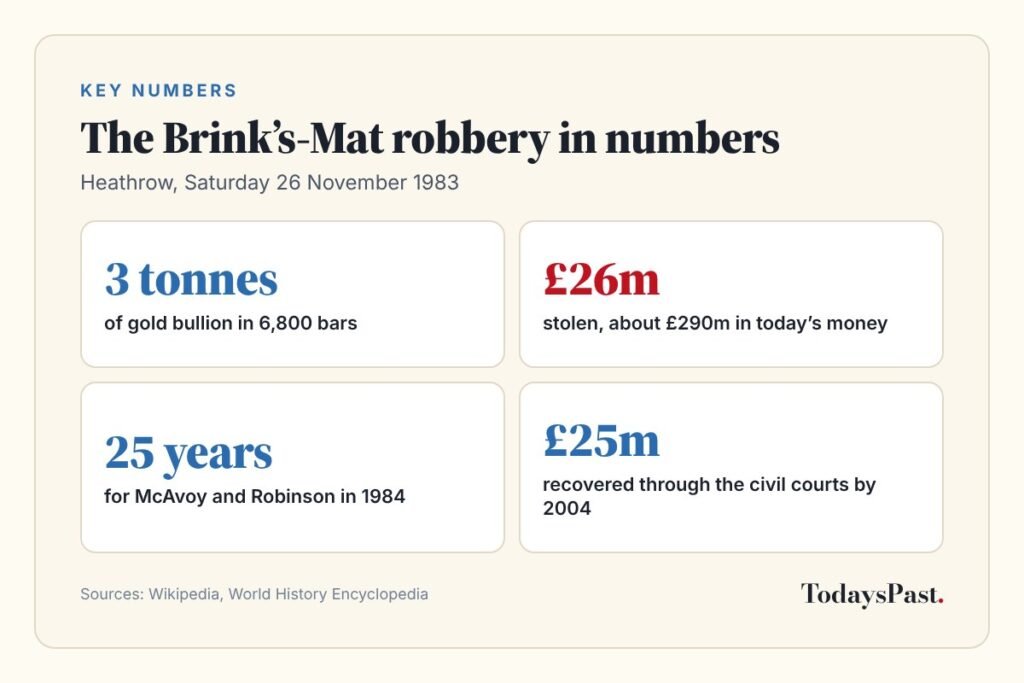
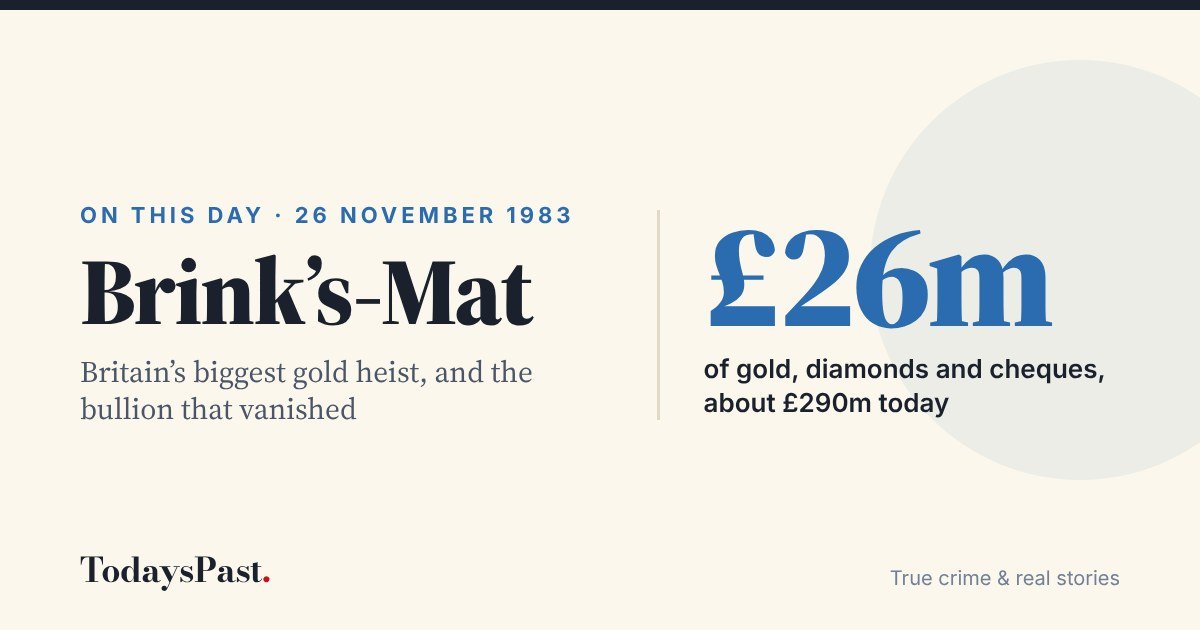
At 6.40am on Saturday 26 November 1983, six armed men walked into a warehouse on the edge of Heathrow Airport expecting to steal a few million pounds in cash. They drove away with three tonnes of gold bullion, plus diamonds and traveller’s cheques, worth £26 million. That is roughly £290 million today. It was the biggest robbery Britain had ever seen, and the search for the gold went on for decades. Most of it has never been found.
This is the story of the Brink’s-Mat robbery: how it happened, how police caught the robbers, where the gold went, and why it is still talked about more than 40 years later.
What happened on 26 November 1983?
The target was Unit 7 on the Heathrow International Trading Estate in west London, a secure warehouse run by Brink’s-Mat. The company was a joint venture between the US security firm Brink’s and the London firm MAT Transport, and it stored valuables passing through Heathrow (Wikipedia).
The gang had help from inside. A security guard, Anthony Black, had given them impressions of the main door key and details of the warehouse’s security. Just after 6.30am he let the robbers in through a poorly secured door (World History Encyclopedia).
Once inside, the robbers tied up and hooded the guards. They poured petrol over them and threatened to set them alight unless they gave up the combinations to the vault. The guards had no choice.
According to most accounts, the gang expected to find a much smaller haul of cash. Instead, waiting outside the main vault ready to be flown to Hong Kong the next day, were three tonnes of pure gold in 6,800 bars. The bullion belonged to Johnson Matthey Bankers. The robbers loaded it into their vans, along with diamonds, platinum and US$250,000 of traveller’s cheques, and were gone by about 8.15am (Crime+Investigation).
How were the robbers caught?
The inside man was the weak link. Detectives soon discovered that Anthony Black’s brother-in-law was Brian Robinson, a known armed robber. Black confessed in December 1983 and became an informer, giving police the names of members of the gang.
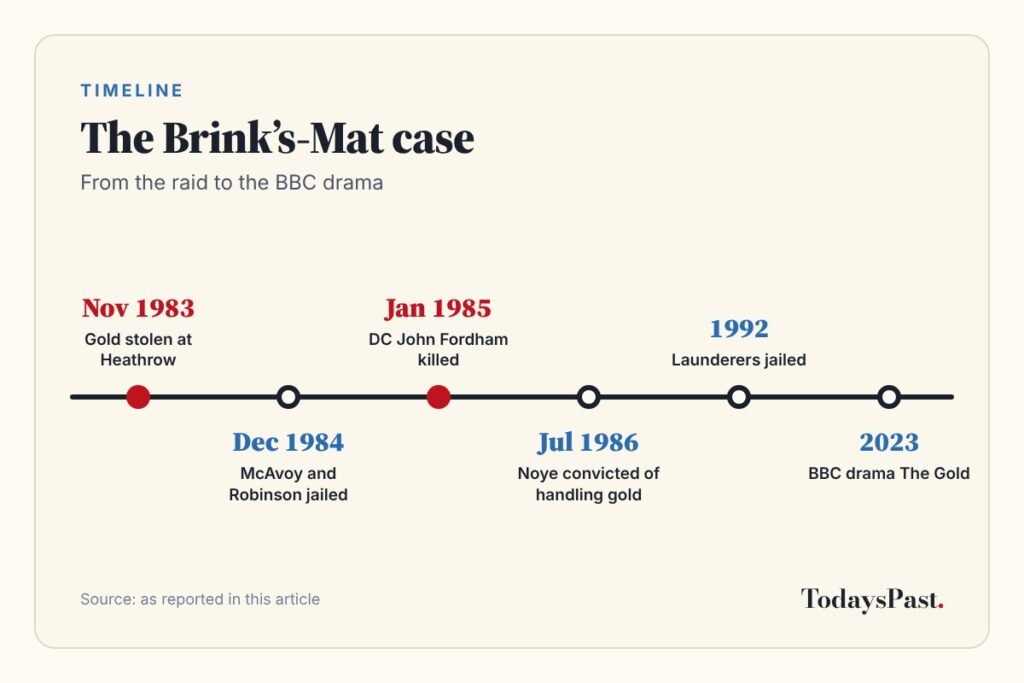
Robinson and Micky McAvoy were arrested within weeks. In December 1984, both were convicted at the Old Bailey and sentenced to 25 years each for armed robbery. They were released in 2000. Black, who gave evidence against them, received six years.
The rest of the gang were never convicted of the robbery itself. The far bigger job for police, as it turned out, was the gold.
What happened to the gold?
Stealing three tonnes of gold is one thing. Selling it is another. Every bar carried serial numbers and assay marks, so the robbers needed help to turn it into money.
McAvoy passed part of his share to associates, including Brian Perry and George Francis. Perry brought in Kenneth Noye, a Kent businessman with criminal links. Gold was smelted down, mixed with copper to disguise where it came from, and recast. Much of it was then sold back into the legitimate market (Wikipedia).
The scale was extraordinary. Around £13 million passed through Barclays branches in the Bristol area. One detective later estimated that anyone who bought gold jewellery in London’s Hatton Garden in the 1980s had a 50:50 chance of wearing Brink’s-Mat gold (World History Encyclopedia).
The money was then laundered through offshore companies, Swiss and Jersey bank accounts, and property. One handler, Gordon Parry, recycled about £10.7 million, including through land in London’s Docklands, just as the area was being redeveloped.
The death of DC John Fordham
The investigation turned fatal in January 1985. Police were watching Kenneth Noye’s home in Kent because they believed he was handling the stolen gold.
On 26 January 1985, Detective Constable John Fordham, 45, an experienced Metropolitan Police surveillance officer, was in the grounds of the house when he was confronted and stabbed by Noye. He was stabbed ten times and died from his injuries. Fordham was wearing camouflage and a balaclava, and Noye told his trial that he had panicked and acted in self-defence. In December 1985, an Old Bailey jury acquitted him of murder. Fordham’s widow said that justice had not been done.
DC Fordham is remembered on the UK’s Police Roll of Honour.
The handling trials
A search of Noye’s home in 1985 found 11 gold bars. In July 1986, Noye was convicted of conspiring to handle gold from the robbery and of a VAT fraud. He was jailed for 14 years and fined £500,000. He served eight years and was released in 1994 (Wikipedia).
More trials followed through the late 1980s and early 1990s. A solicitor, Michael Relton, was jailed for 12 years in 1988 for helping to launder the proceeds. In 1992, Gordon Parry and Brian Perry were jailed for handling the money, along with two others.
Jeweller John Palmer, who owned the property near Bath where a smelter was found, was acquitted in 1987 of handling the gold.
How much of the gold was recovered?
Very little of the gold itself. A record £2 million reward was offered for information, but much of the three tonnes was never found. It is thought that about half was smelted and sold back into the legitimate market. The rest may have been hidden and never recovered.
The money side went better for the victims. Lloyd’s of London paid a then-record £26 million insurance claim, and the insurers’ lawyers spent years chasing the proceeds through the civil courts. In 1995, the High Court ordered McAvoy to repay more than £27 million. By 2004, about £25 million had been recovered, including £3 million from Noye (Wikipedia).
The “curse of Brink’s-Mat”
In the years after the robbery, a number of people linked to the case in press reports died violently, including Brian Perry, who was shot in 2001, and George Francis, who was shot in 2003. John Palmer was shot dead at his home in Essex in 2015. Newspapers came to call this the “curse of Brink’s-Mat”. However, there is no evidence that all these deaths were connected to each other or to the gold, and most remain unsolved.
Kenneth Noye’s own story took a darker turn. In 1996, while on licence, he stabbed 21-year-old Stephen Cameron to death in a road-rage attack on an M25 slip road in Kent. He fled abroad, was arrested in Spain in 1998, and was jailed for life in 2000. He was released on licence in 2019 (ITV News).
Why the Brink’s-Mat robbery still matters
- It exposed how easily dirty money moved through banks. Millions in cash were paid in with few questions asked, and the case is widely seen as one of the reasons UK banks now have to scrutinise large cash deposits.
- It reshaped how police chase criminal money. Brink’s-Mat showed that catching robbers was only half the job; following the money mattered just as much.
- Johnson Matthey Bankers collapsed in 1984 and was rescued by the Bank of England. The robbery was not the cause, which was bad lending, but the losses came in the same difficult year.
- It is still on screen. The BBC drama The Gold, starring Hugh Bonneville, Jack Lowden and Dominic Cooper, first aired in February 2023, and a second series followed in 2025.
Brink’s-Mat: key facts
| Fact | Detail |
|---|---|
| Date | 26 November 1983, about 6.40am |
| Place | Unit 7, Heathrow International Trading Estate, west London |
| Robbers | Six armed men, helped by an inside man |
| Stolen | About 3 tonnes of gold (6,800 bars), plus diamonds and traveller’s cheques |
| Value | £26 million then, roughly £290 million today |
| Convicted of the robbery | Micky McAvoy and Brian Robinson (25 years each); inside man Anthony Black (6 years) |
| Gold recovered | Only a small fraction; much was never found |
Frequently asked questions
What was the Brink’s-Mat robbery?
It was an armed robbery on 26 November 1983 at a Brink’s-Mat warehouse near Heathrow Airport. Six robbers stole about three tonnes of gold bullion, plus diamonds and traveller’s cheques, worth £26 million at the time.
How much would the Brink’s-Mat gold be worth today?
The £26 million haul is equivalent to roughly £290 million in today’s money, adjusted for inflation. The gold itself would be worth far more at current gold prices.
Was the Brink’s-Mat gold ever found?
Mostly not. About half is thought to have been smelted and sold back into the legitimate gold market. Much of the rest has never been recovered, although insurers later recovered about £25 million through the civil courts.
Who was convicted of the Brink’s-Mat robbery?
Micky McAvoy and Brian Robinson were jailed for 25 years in 1984. Security guard Anthony Black, the inside man, was jailed for six years. Several others, including Kenneth Noye, were later convicted of handling the gold or laundering the money.
Is The Gold on BBC a true story?
Yes. The BBC drama The Gold is based on the Brink’s-Mat robbery and the hunt for the stolen bullion, although some characters and scenes are dramatised.
Who killed DC John Fordham?
DC John Fordham was stabbed in the grounds of Kenneth Noye’s home in Kent on 26 January 1985 while watching the property as part of the Brink’s-Mat investigation. Noye was acquitted of murder in December 1985 after saying he acted in self-defence.
Sources: Wikipedia: Brink’s-Mat robbery; World History Encyclopedia; Crime+Investigation timeline; Wikipedia: Kenneth Noye; ITV News, June 2019; contemporary reports of the 1985 trial. Published for the 43rd anniversary of the robbery.