How to Calculate Percentage Increase, Decrease and Change (With UK Examples)
Your rent has gone up from £950 to £1,020 a month. Your energy bill has dropped. A shop says a jacket is “30% off”. In each case, the question is the same: by what percentage did it change?
This guide shows you how to work out a percentage increase, a percentage decrease and a percentage change, with real UK examples and the mistakes that catch most people out. If you just want the answer, our free percentage calculator does the sum and shows the working.
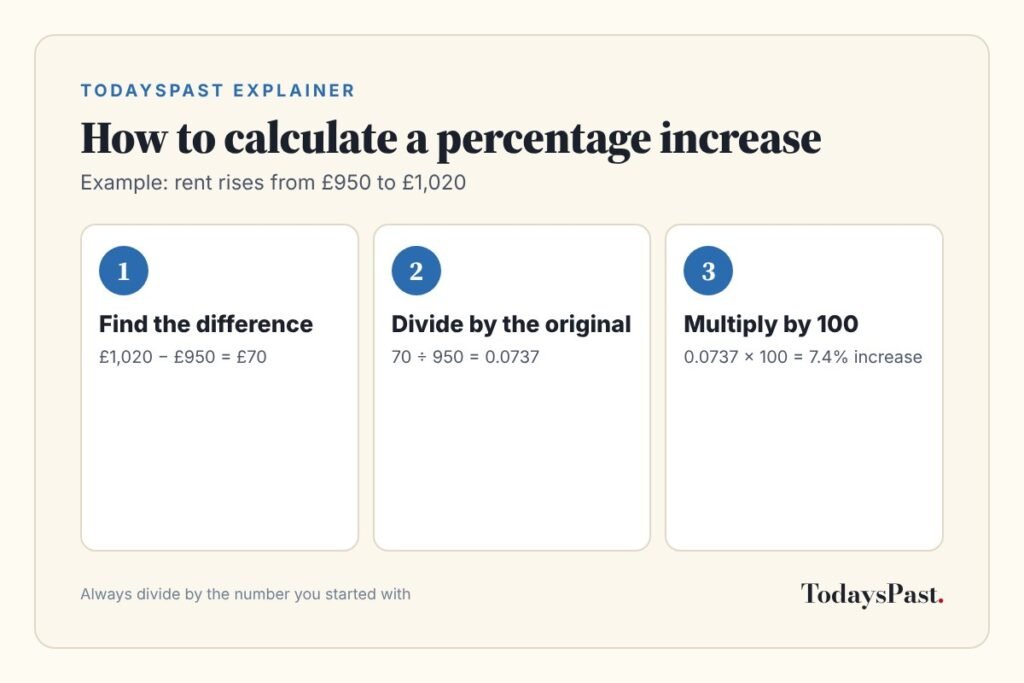
How to calculate a percentage increase
Use this formula:
Percentage increase = (new value − original value) ÷ original value × 100
In three steps:
- Find the difference. Take the original number away from the new number.
- Divide by the original. Always divide by the number you started with, not the new one.
- Multiply by 100 to turn the answer into a percentage.
Example: a rent increase
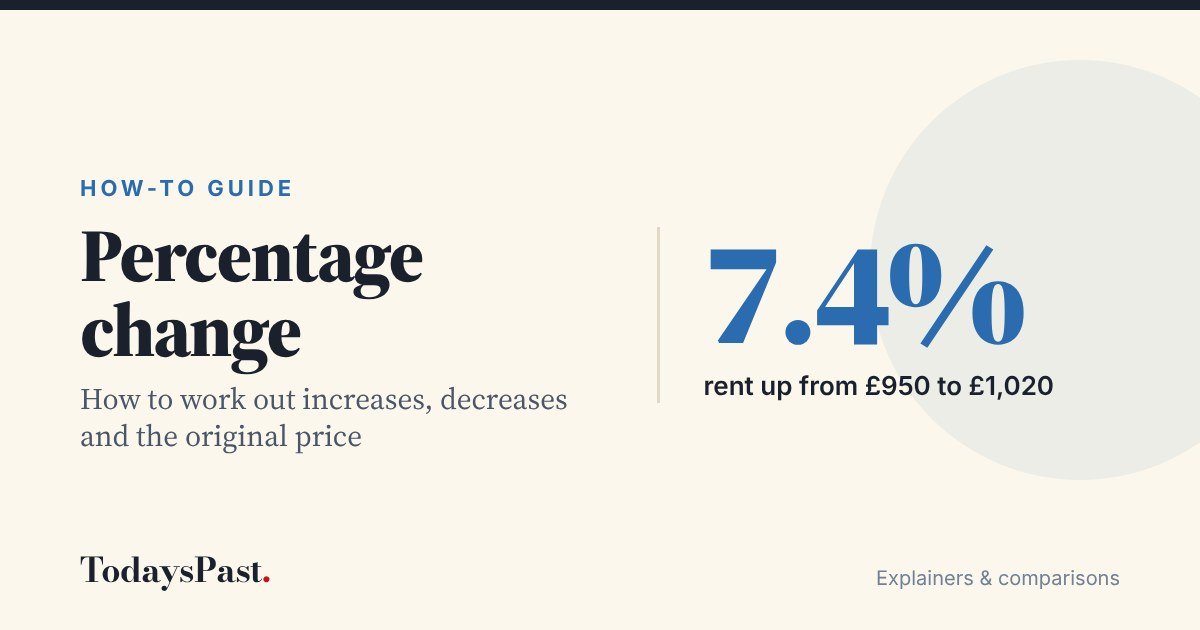
Your rent goes from £950 to £1,020 a month.
- Difference: £1,020 − £950 = £70
- Divide by the original: 70 ÷ 950 = 0.0737
- Multiply by 100: 7.4% increase
Example: a pay rise
Your salary rises from £28,000 to £29,400. The difference is £1,400, and 1,400 ÷ 28,000 = 0.05, so it is a 5% pay rise. To see what that means after tax, try our take-home pay calculator.
How to calculate a percentage decrease
It is the same method, but the difference is taken the other way round:
Percentage decrease = (original value − new value) ÷ original value × 100
Example: a TV drops from £499 to £379 in a sale. The difference is £120. 120 ÷ 499 = 0.240, so the price has fallen by 24%.
What is percentage change?
“Percentage change” covers both. You use one formula, and the sign of the answer tells you which way it went:
Percentage change = (new − old) ÷ old × 100
- A positive answer is an increase.
- A negative answer is a decrease.
So the TV above is a change of (379 − 499) ÷ 499 × 100 = −24%.
Working backwards: finding the original price
Sometimes you know the price after a percentage change and want the price before it. This is called a reverse percentage, and it is where most people go wrong.
Example: a train ticket costs £46 after a 15% increase. What was it before?
- Wrong: take 15% off £46 = £39.10
- Right: divide by 1.15 → £46 ÷ 1.15 = £40
The 15% was added to the old price, not the new one, so you divide by 1.15 to undo it. For a decrease, you divide instead: a coat that costs £63 after 30% off was £63 ÷ 0.70 = £90. The same trick is how you take VAT off a price; our VAT calculator does it for you.
Common mistakes to avoid
1. Dividing by the wrong number
Always divide by the original value. A rise from 50 to 75 is a 50% increase (25 ÷ 50). But a fall from 75 to 50 is a 33.3% decrease (25 ÷ 75). Same gap, different answers.
2. Adding percentages one after another
A 10% rise followed by a 10% fall does not bring you back to where you started. £100 rises to £110, then falls 10% to £99. To combine changes, multiply: 1.10 × 0.90 = 0.99, a 1% fall overall.
3. Confusing percentages with percentage points
If a savings rate goes from 4% to 5%, it has risen by 1 percentage point, but by 25% (1 ÷ 4). News reports about interest rates and inflation often use percentage points, so check which one you are reading.
How to calculate percentage change in Excel or Google Sheets
Put the old value in cell A2 and the new value in B2, then type:
=(B2-A2)/A2
Format the cell as a percentage and the spreadsheet will show it as, for example, 7.4%. Drag the formula down to work out a whole column of changes at once.
Quick reference
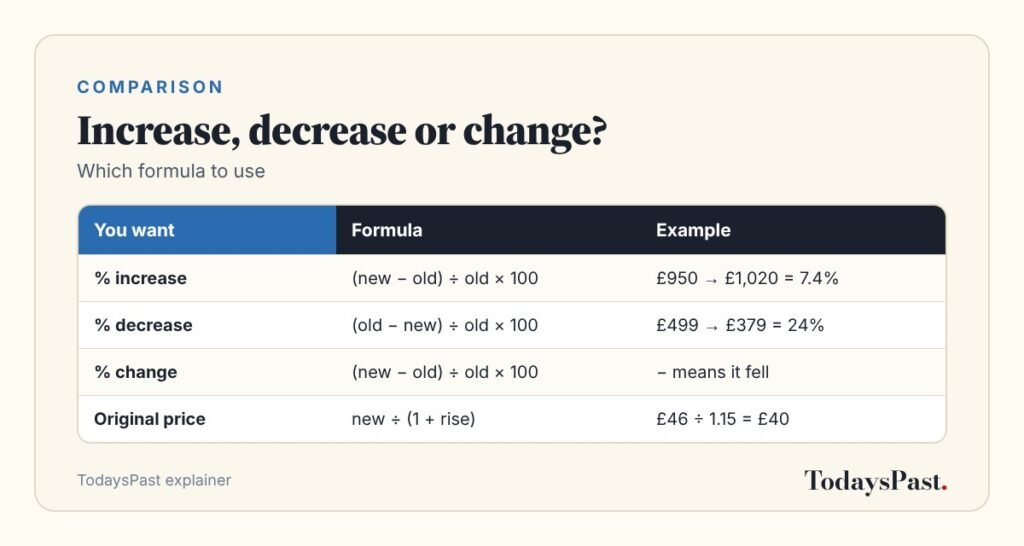
| You want to know | Formula | Example |
|---|---|---|
| Percentage increase | (new − old) ÷ old × 100 | £950 → £1,020 = 7.4% |
| Percentage decrease | (old − new) ÷ old × 100 | £499 → £379 = 24% |
| Original before a rise | new ÷ (1 + rise) | £46 ÷ 1.15 = £40 |
| Original before a cut | new ÷ (1 − cut) | £63 ÷ 0.70 = £90 |
| X% of a number | number × X ÷ 100 | 20% of £85 = £17 |
Related reading
- ISA vs Savings Account — Which Is Better in 2026?
- Calorie Deficit Explained: How to Set a Safe, Sustainable Target
- BMR vs TDEE: What’s the Difference, and Which Should You Use?
Frequently asked questions
How do I calculate the percentage increase between two numbers?
Subtract the original number from the new number, divide the result by the original number, then multiply by 100. For example, from 40 to 50: (50 − 40) ÷ 40 × 100 = 25%.
What is the formula for percentage change?
Percentage change = (new value − old value) ÷ old value × 100. A positive result is an increase and a negative result is a decrease.
Why is a 50% increase not undone by a 50% decrease?
Because each percentage is worked out from a different starting number. £100 increased by 50% is £150, but 50% of £150 is £75, so a 50% decrease takes you to £75, not back to £100.
How do I work out a percentage increase on a calculator?
Type the new number, subtract the old number, divide by the old number, then multiply by 100. On many phone calculators you can type (1020 − 950) ÷ 950 × 100 and get 7.37.
What is the difference between a percentage and a percentage point?
A percentage point is the simple difference between two percentages. Going from 4% to 5% is a rise of 1 percentage point, which is a 25% increase in the rate itself.
Can a percentage increase be more than 100%?
Yes. If something more than doubles, the increase is over 100%. A house bought for £120,000 and sold for £300,000 has gone up by 150%.