How to Calculate Holiday Entitlement in the UK (Including Part-Time and Zero-Hours)
Almost every worker in the UK has a legal right to paid holiday, whether you are full time, part time, on a zero-hours contract or working through an agency. The tricky part is working out exactly how much you are owed, especially if you work part time, have just started a job, or your hours change from week to week.
This guide explains the rules for England, Scotland and Wales in plain English, with worked examples for each type of worker. Northern Ireland has similar rules but some details differ.
How much holiday are you entitled to?
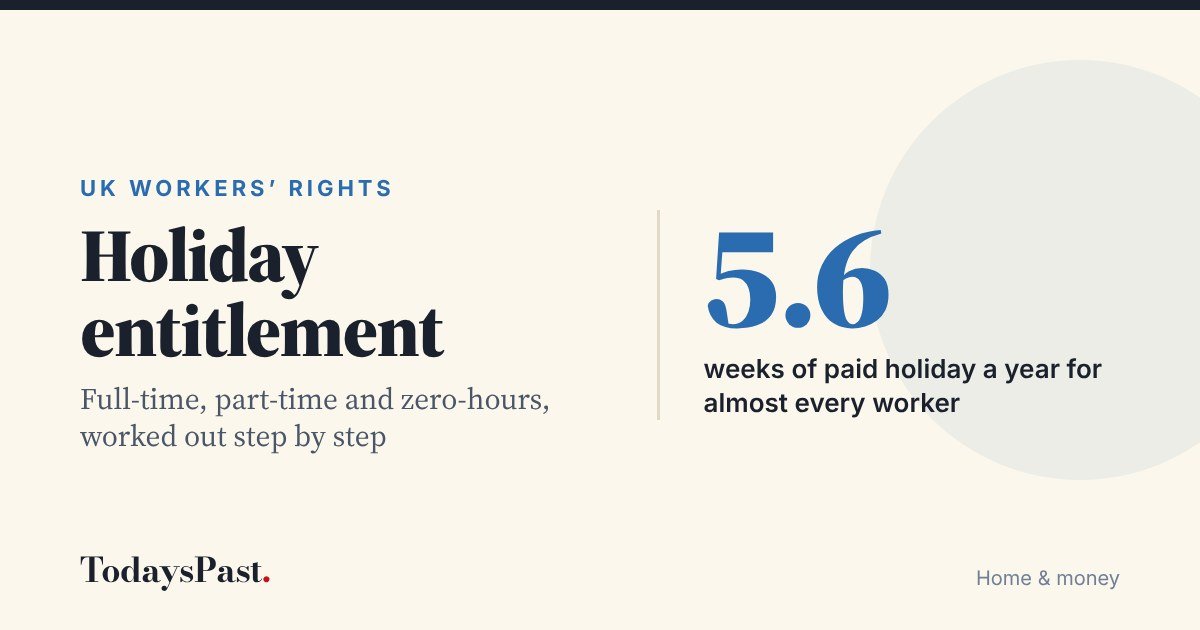
Almost all workers are entitled to 5.6 weeks of paid holiday a year. This is the legal minimum, and it includes agency workers, irregular-hours workers and part-year workers (GOV.UK).
For someone who works five days a week, 5.6 weeks works out at 28 days. Statutory paid holiday is capped at 28 days, so someone working six days a week is still only entitled to 28 days by law.
Your employer can give you more than this, and many do. Anything above the legal minimum is set by your contract.
How to calculate holiday entitlement
If you work the same days every week
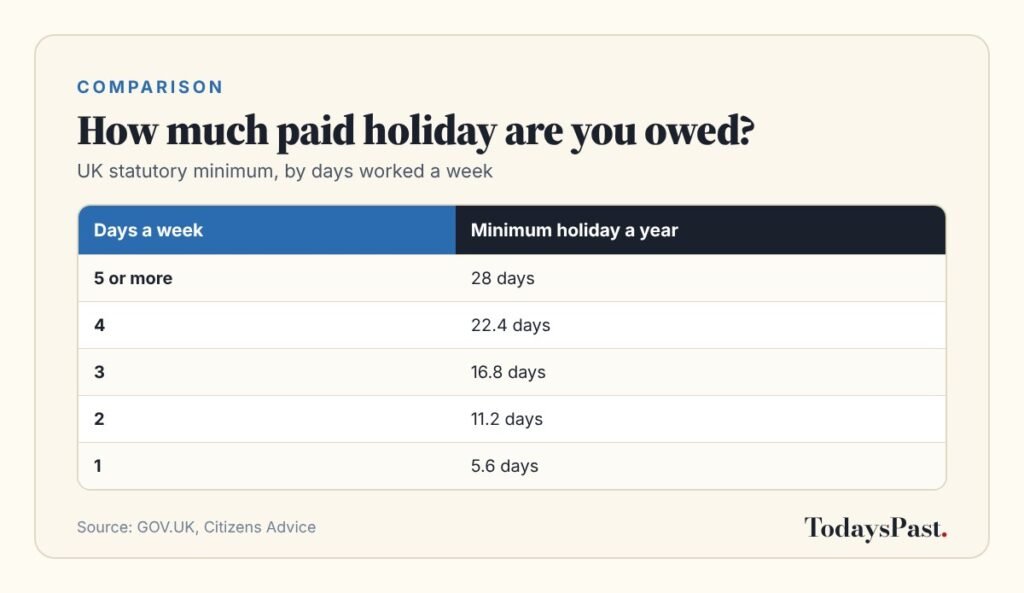
Multiply the number of days you work each week by 5.6.
| Days worked a week | Minimum paid holiday a year |
|---|---|
| 5 or more | 28 days |
| 4 | 22.4 days |
| 3 | 16.8 days |
| 2 | 11.2 days |
| 1 | 5.6 days |
Example: Priya works three days a week. 3 × 5.6 = 16.8 days of paid holiday a year (Citizens Advice).
If you work the same hours, but on different days
Multiply your weekly hours by 5.6 to get your entitlement in hours. Someone who works 22.5 hours a week is entitled to 22.5 × 5.6 = 126 hours of paid holiday a year.
If you work part time
Part-time workers get the same 5.6 weeks as full-time staff, just scaled to the days or hours they work. This is called pro rata holiday. Our pro rata salary calculator works out your part-time pay and holiday in one go, and our guide to working out your hourly rate shows what that pay is worth per hour.
Irregular hours, zero-hours and part-year workers
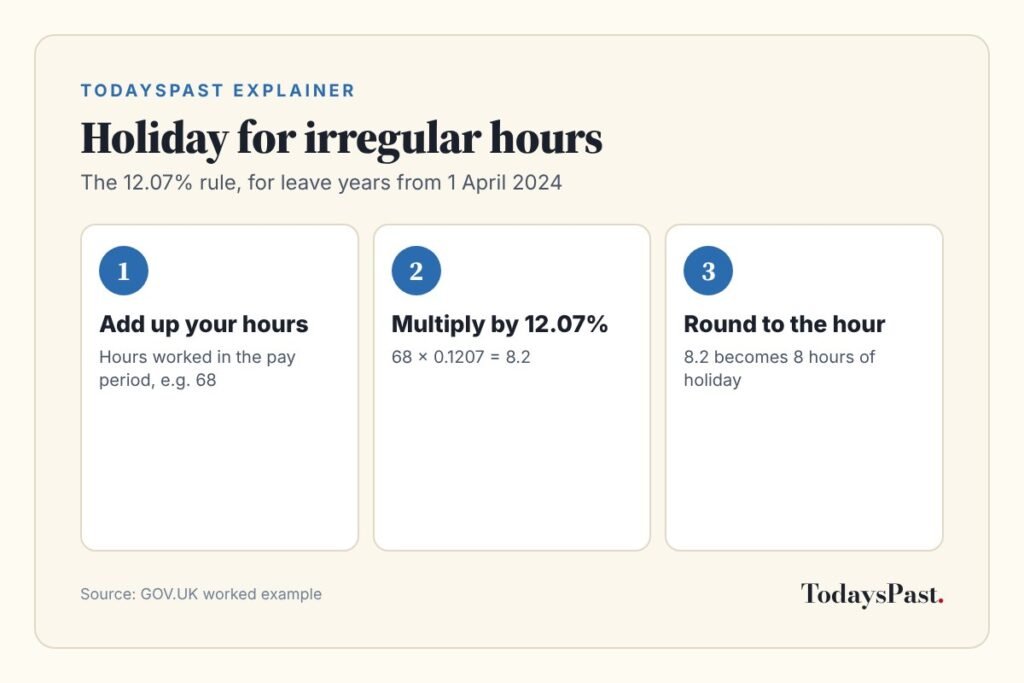
If your hours change from week to week, or you only work some of the year (for example, term-time staff), different rules apply. For leave years that started on or after 1 April 2024, you build up holiday at 12.07% of the hours you actually work in each pay period (Acas).
Why 12.07%? Because 5.6 weeks of holiday divided by the 46.4 weeks you would work in a year (52 − 5.6) is 0.1207.
Example: Jill works irregular hours and is paid monthly. In June she works 68 hours. 68 × 12.07% = 8.2 hours, which is rounded to 8 hours of holiday (GOV.UK worked example).
What is rolled-up holiday pay?
For irregular-hours and part-year workers only, employers can now choose to pay holiday as you go: an extra 12.07% added to your pay each pay day, instead of paying you when you take leave. This is called rolled-up holiday pay. It must be shown as a separate line on your payslip, and you still have the right to take time off.
Holiday in your first year of a new job
You start building up holiday from your first day. In the first year, your employer can use an accrual system, where you build up one-twelfth of your yearly entitlement each month.
Example: you work five days a week and are entitled to 28 days. After three months you will have built up 7 days (28 ÷ 12 × 3) (GOV.UK). Some employers let you take holiday before you have built it up, but they do not have to.
If you start part way through your employer’s leave year, your entitlement for that year is reduced in proportion. GOV.UK has a free holiday entitlement calculator for this.
Do bank holidays count?
There is no legal right to paid leave on bank holidays. Your employer can count bank holidays as part of your 28 days, which is very common, or give them on top. Check your contract.
For part-time staff, this can cause problems. If you never work Mondays, you will miss out on most bank holidays. The fair approach is to give part-time staff a pro rata share of bank holidays added to their entitlement, then require them to book off any bank holidays that fall on their working days.
Can you carry holiday over?
Your contract sets out how much holiday you can carry into the next leave year. Under the law, the first 4 weeks of statutory leave should normally be taken in the year it is earned, while the extra 1.6 weeks can be carried over if your employer agrees.
There are exceptions. If you could not take your holiday because you were off sick or on maternity, paternity or adoption leave, you can usually carry it over (Acas).
What happens to your holiday when you leave a job?
If you leave with holiday you have built up but not taken, your employer must pay you for it. This is called payment in lieu. It can include holiday carried over from earlier years. If you have taken more holiday than you had built up, your employer can take the extra back from your final pay, but only if your contract allows it.
Your employer can also ask you to use up your remaining holiday during your notice period.
Holiday while off sick or on maternity leave
You keep building up holiday while you are off sick and during maternity, paternity and adoption leave. You can also ask to take holiday while you are off sick, for example to be paid your normal holiday pay instead of statutory sick pay.
If you think you are not getting your holiday
Paid annual leave is a legal right. If you think you are being short-changed, start by raising it with your employer, ideally in writing. If that does not work, Acas offers free, confidential advice on 0300 123 1100, and you may be able to make a claim to an employment tribunal.
Related reading
- How to Calculate Your Hourly Rate From Your Salary (UK, 2026/27)
- Compound Interest Explained: How It Works, With UK Examples
- Cash ISA Allowance Stays at £20,000: What Changed
Frequently asked questions
How many days holiday do I get if I work 3 days a week?
At least 16.8 days a year: 3 days × 5.6 weeks. Your employer may round this up or give you more under your contract.
How is holiday calculated for zero-hours contracts?
For leave years starting on or after 1 April 2024, you build up holiday at 12.07% of the hours you work in each pay period. If you work 100 hours in a month, you build up about 12 hours of holiday.
Are bank holidays included in my 28 days?
They can be. There is no legal right to paid bank holidays on top of your 5.6 weeks, so many employers include the UK’s 8 bank holidays within the 28 days. Your contract will say which applies to you.
Can my employer refuse my holiday request?
Yes, but they must give you notice. By law, they must give at least as many days’ notice as the length of holiday you asked for. Your employer can also tell you when to take holiday, for example over Christmas, if they give enough notice.
Do I get paid for unused holiday when I leave?
Yes. Your employer must pay you for any statutory holiday you have built up but not taken by the time you leave.
Do I build up holiday while I am off sick?
Yes. You continue to build up statutory holiday while you are off sick, and you can usually carry it over if you could not take it because of illness.
Sources: GOV.UK: Holiday entitlement; GOV.UK: Holiday pay and entitlement reforms; Acas: Irregular hours and part-year workers; Citizens Advice. This guide gives general information, not legal advice.