Compound Interest Explained: How It Works, With UK Examples
Compound interest is interest earned on your interest. In the first year, it barely makes a difference. Leave your money alone for long enough, though, and it can do more of the work than you do.
This guide explains how it works, the simple formula behind it, and how to use it to plan your savings, with worked examples you can follow on a calculator.
What is compound interest?
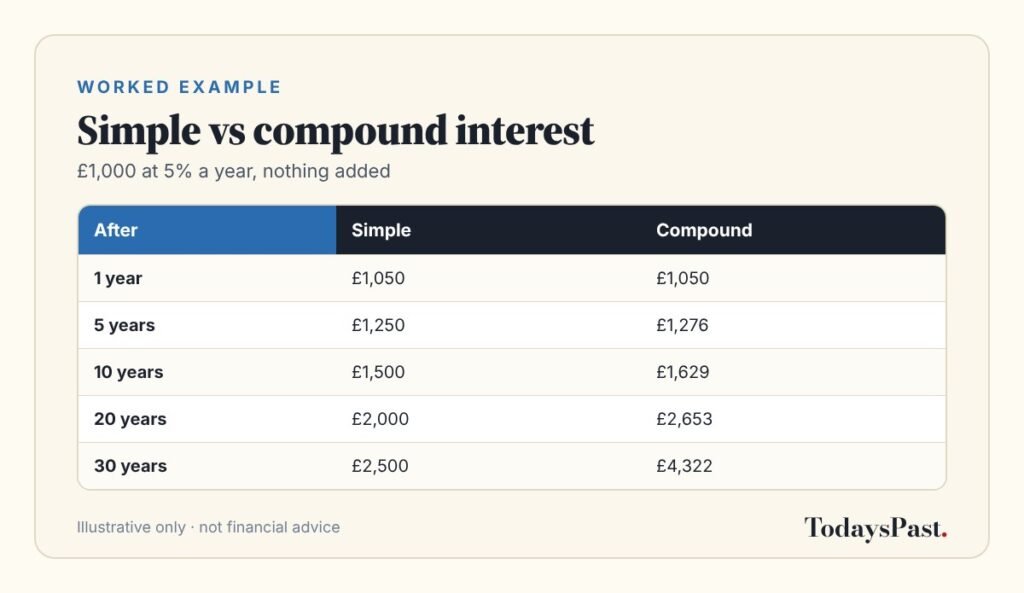
With simple interest, you only ever earn interest on the money you put in. £1,000 at 5% earns £50 a year, every year.
With compound interest, the interest is added to your balance, so next year you earn interest on the bigger amount. £1,000 at 5% earns £50 in year one, then £52.50 in year two (5% of £1,050), then £55.13 in year three, and so on.
The gap looks tiny at first. After 30 years, simple interest turns £1,000 into £2,500. Compound interest turns it into about £4,322.
The compound interest formula
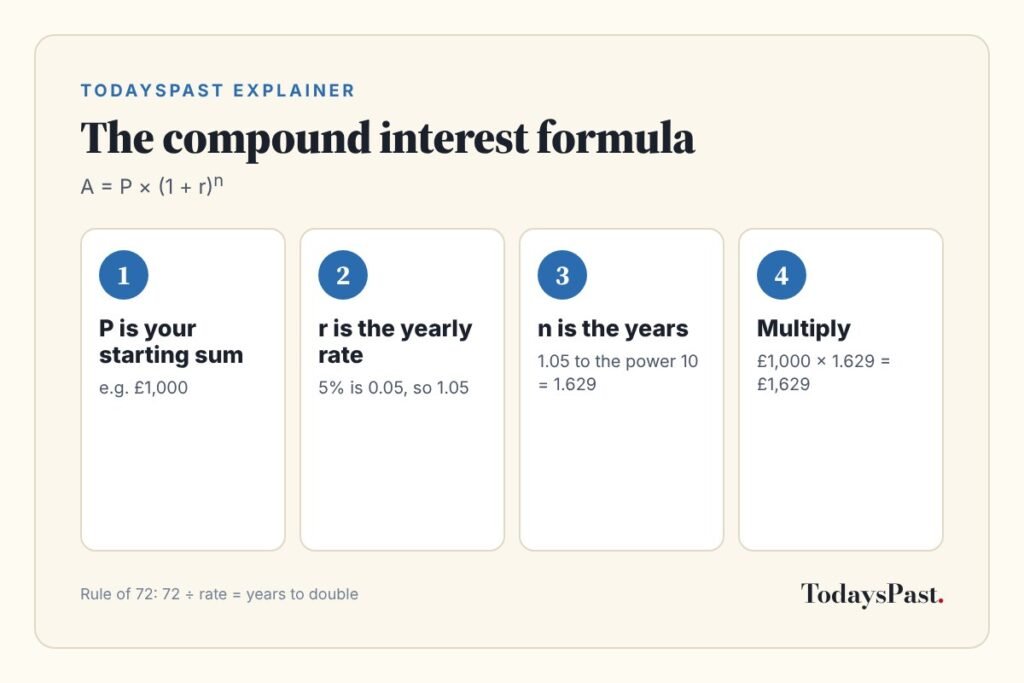
A = P × (1 + r)n
- A is the amount you end up with.
- P is the amount you start with (the principal).
- r is the yearly interest rate as a decimal, so 5% is 0.05.
- n is the number of years.
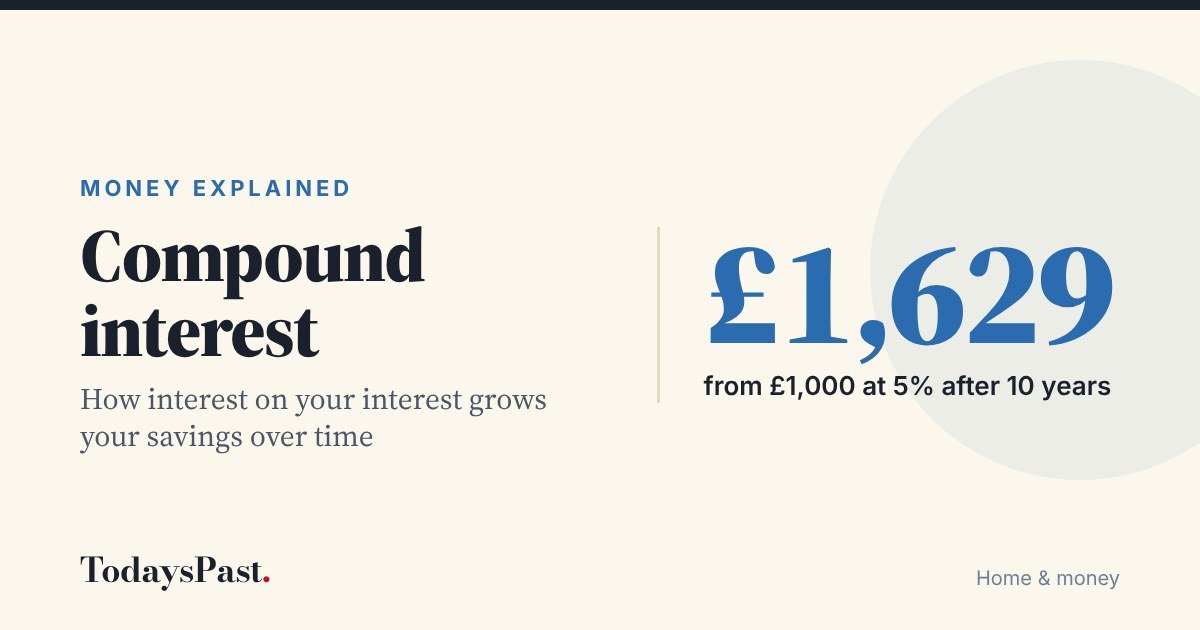
Example: £1,000 at 5% for 10 years. 1.05 to the power of 10 is 1.629. £1,000 × 1.629 = £1,629. On most phone calculators, turn sideways and use the xy button.
What if interest is paid monthly?
If interest is added monthly, divide the rate by 12 and multiply the years by 12. £1,000 at 5% compounded monthly for 10 years becomes about £1,647, slightly more than with yearly compounding. This is why UK savings accounts quote an AER (annual equivalent rate): it shows the yearly rate once compounding is taken into account, so you can compare accounts fairly.
Compound interest when you save every month
Most people do not just put in a lump sum. They save a bit each month. Here is what £100 a month grows to at 5% a year, compounded monthly:
| Saving for | You put in | Value at 5% | Growth from interest |
|---|---|---|---|
| 10 years | £12,000 | £15,528 | £3,528 |
| 20 years | £24,000 | £41,103 | £17,103 |
| 30 years | £36,000 | £83,226 | £47,226 |
After 30 years, more of the pot comes from interest than from the money you paid in. That is the main lesson of compound interest: starting early matters more than saving a lot.
The rule of 72
A quick way to estimate how long it takes to double your money: divide 72 by the interest rate. At 5%, money doubles in about 72 ÷ 5 = 14.4 years. At 8%, about 9 years. It is an estimate, but a useful one.
Watch out: inflation and debt
- Inflation works like compound interest in reverse. If prices rise faster than your savings rate, your money buys less over time, even as the balance grows. Our UK inflation calculator shows how much prices have changed.
- Debt compounds too. Credit cards and loans charge interest on unpaid interest, which is why a balance can grow quickly. The same maths that helps your savings works against you here.
- Rates change. The 5% used in these examples is for illustration. Real savings rates go up and down, and investments can fall in value.
To work out percentage changes quickly, try our percentage calculator, or read our guide to calculating a percentage increase. If you are deciding where to keep your savings, see what changed with the Cash ISA allowance.
Related reading
- Cash ISA Allowance Stays at £20,000: What Changed
- UK Mortgage Rates Explained: Fixed, Tracker and Switching Costs
- How to Calculate Your Hourly Rate From Your Salary (UK, 2026/27)
Frequently asked questions
Frequently asked questions
What is compound interest in simple terms?
It is interest earned on your interest. Each time interest is added, the next lot of interest is worked out on the new, bigger balance.
What is the formula for compound interest?
A = P × (1 + r)n, where P is your starting amount, r is the yearly rate as a decimal and n is the number of years.
How much is £1,000 at 5% compound interest for 10 years?
About £1,629 if interest is added yearly, or about £1,647 if it is added monthly.
What is the difference between simple and compound interest?
Simple interest is only paid on the money you put in. Compound interest is also paid on the interest you have already earned, so it grows faster over time.
What is AER?
AER stands for annual equivalent rate. It shows what the interest rate would be over a year once compounding is included, so you can compare savings accounts fairly.
How long does it take to double money with compound interest?
Use the rule of 72: divide 72 by the interest rate. At 5%, it takes about 14.4 years.
All figures are illustrative and calculated by TodaysPast. They ignore tax and fees. This is not financial advice: speak to a regulated financial adviser before making investment decisions.