How Many Steps a Day to Lose Weight? What the Evidence Does—and Does Not—Say
There is no single number of daily steps that guarantees weight loss for everyone. Steps can be a useful way to track movement, but weight change also depends on food intake, overall activity, sleep, health conditions and how consistently a routine is maintained.
A more useful question is: how many steps can I add sustainably, alongside an eating pattern that supports my goal?
Published 21 November 2026. General information, not personalised medical or fitness advice.
What does research suggest?
Research does not identify one universal step target that produces weight loss. A 2026 systematic review and meta-analysis of daily steps during nutritional lifestyle-modification programmes found that increasing steps was associated with greater weight loss; across the included interventions, the average daily step count was about 8,500 steps. That does not mean 8,500 steps is a required target or a guarantee for every person. See the study, Daily Steps During Nutritional Lifestyle Modification Programs for Obesity Management.
Walking can support a calorie deficit because it increases energy expenditure. However, food intake remains central: the CDC notes that most weight loss comes from reducing calorie intake, while regular physical activity helps maintain weight loss. See the CDC guidance on physical activity, weight and health.
Is 10,000 steps a day necessary?
No. The familiar 10,000-step target is popular, but it is not a universal medical prescription. A systematic review of prospective studies found health benefits below 10,000 daily steps and concluded that evidence was insufficient to identify one minimum threshold for overall benefit. See the systematic review of daily step counts and health outcomes.
For some people, 6,000 steps may be a meaningful improvement; for others, 10,000 or more may be manageable. The best starting point is your current average, not an arbitrary number.
How to choose a realistic target
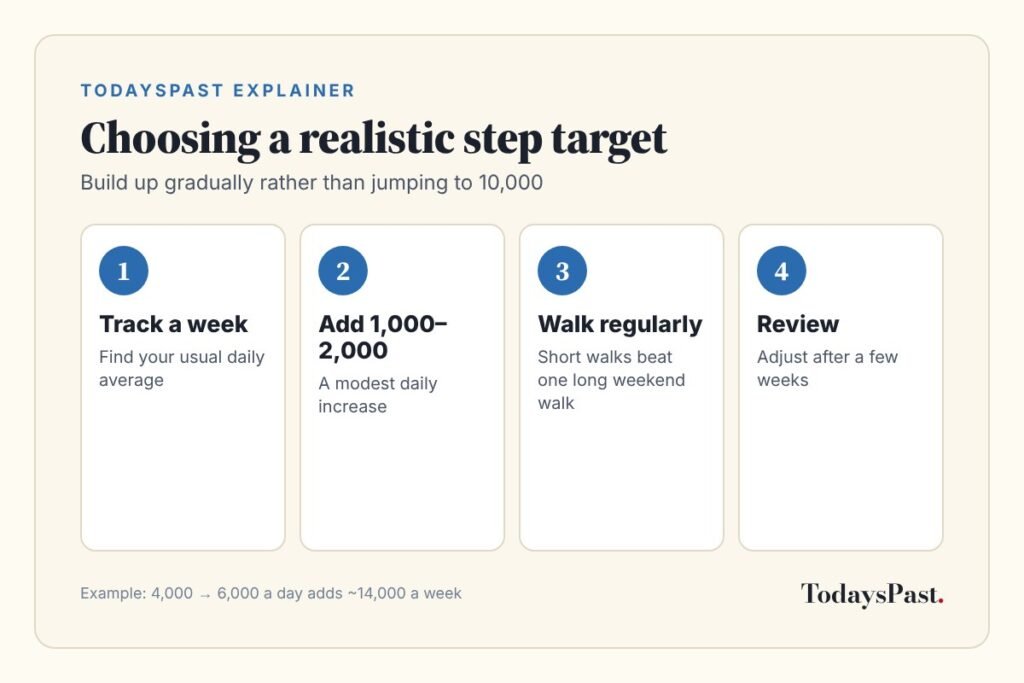
If you currently average 4,000 steps a day, jumping straight to 10,000 may feel overwhelming. A gradual increase can be easier to maintain.
- Track your usual daily steps for a week.
- Choose a modest increase, such as 1,000–2,000 steps per day.
- Build in regular walks rather than relying on one long weekend walk.
- Review after a few weeks and adjust only if the routine remains realistic.
For example, moving from 4,000 to 6,000 steps daily adds about 14,000 steps per week. That may be more sustainable than attempting an immediate 10,000-step daily target.
Does walking pace matter?
Yes. Pace affects how demanding a walk feels and how much energy it uses. Brisk walking is generally considered moderate-intensity activity; the UK Chief Medical Officers’ guidance describes at least 150 minutes of moderate-intensity activity per week for adults, including brisk walking. See the UK physical activity guidelines.
Steps alone do not capture intensity, terrain, incline, carrying a load or fitness level. Two people can record the same step count but have very different walks.
Steps are only one measure
A step counter does not measure diet quality, strength training, sleep, stress or medical factors. It also cannot tell you whether a particular daily target is appropriate for you.
Use steps as one signal among several: consistency, how you feel, strength and mobility activity, and longer-term weight trends. Physical activity has benefits beyond weight change, including cardiovascular and general health benefits. See the CDC overview of the benefits of physical activity.
Using the TodaysPast walking tool
The TodaysPast Walking Weight Loss tool can help you explore estimates based on walking inputs. Treat its result as an estimate, not a personalised plan or a promise of a particular result.
For context on creating a calorie deficit, see our calorie-deficit explainer.
Frequently asked questions
Is 10,000 steps a day good for weight loss?
It can be a useful activity goal for some people, but it is not required. A sustainable increase from your current routine matters more than reaching a specific universal number.
Can I lose weight by walking alone?
Walking can contribute to a calorie deficit, but weight change also depends largely on food intake and overall lifestyle. Walking alone may not produce the result someone expects.
How many steps should a beginner aim for?
There is no single beginner target. Start by measuring your usual average, then add a manageable amount—such as 1,000–2,000 steps per day—and build gradually.
Do steps count if I walk slowly?
Yes. All movement contributes to daily activity, although slower walking generally uses less energy per minute than brisk walking.
This article provides general information about walking, steps and weight management. It is not medical advice or a personalised exercise prescription. Seek individual advice from an appropriately qualified healthcare professional if needed.