The Great Train Robbery: What Really Happened on 8 August 1963
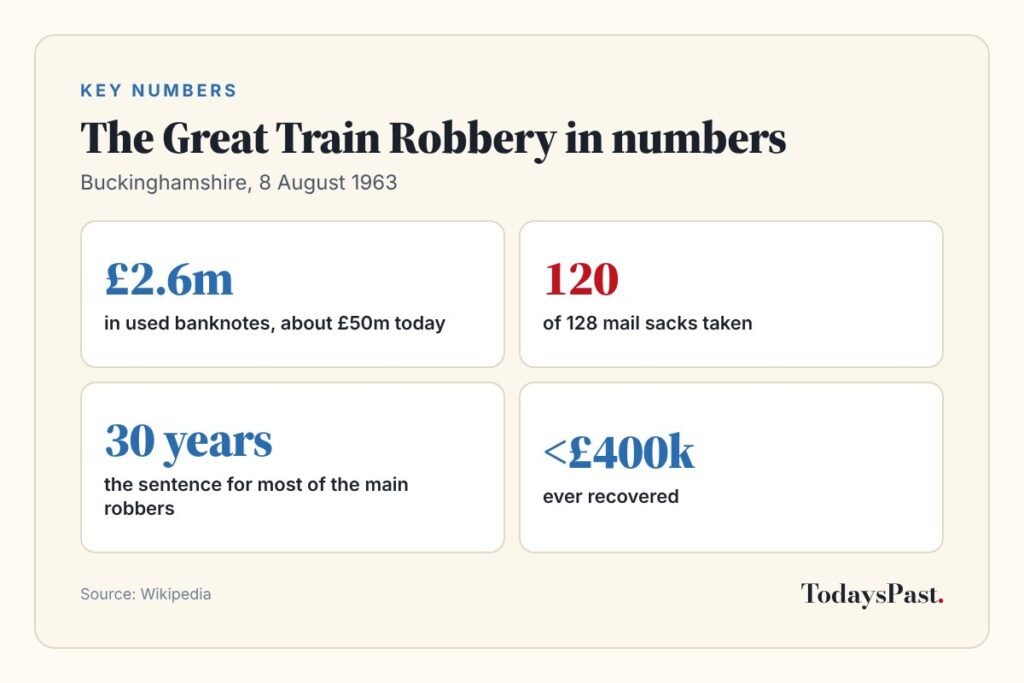
In the early hours of Thursday 8 August 1963, a gang of around 15 men stopped the Royal Mail overnight train from Glasgow to London in the Buckinghamshire countryside. In about half an hour they unloaded £2.6 million in used banknotes, the equivalent of around £50 million today. Less than £400,000 was ever recovered.
The Great Train Robbery became the most famous crime in British history. It made household names of men like Ronnie Biggs and Bruce Reynolds, and it is still argued about more than 60 years later. This is what really happened.
What happened on 8 August 1963?
The target was the Up Special, a travelling post office train that sorted mail as it travelled overnight from Glasgow to Euston. Its second carriage carried high-value packages, mostly used banknotes being sent back to London after the August bank holiday weekend.
Just after 3am, at Sears Crossing near Ledburn, the driver, Jack Mills, saw the signal turn red and stopped the train. The gang had tampered with it: they covered the green light and wired the red one to a battery (Wikipedia). When the second crew member, David Whitby, climbed down to phone the signal box, he found the line had been cut.
The robbers uncoupled the engine and the front two carriages, and forced Mills to drive them a short distance to Bridego Bridge, where vehicles were waiting below. During the attack Mills was struck on the head and badly injured. The gang formed a human chain and passed 120 of the 128 mail sacks down the embankment, then drove away.
Who were the Great Train Robbers?
Accounts differ, but the gang had about 15 or 16 members, most from south London. They included:
- Bruce Reynolds, usually described as the leader and planner.
- Gordon Goody and Buster Edwards, among the main organisers.
- Charlie Wilson, Roy James, Jimmy White, Tommy Wisbey, Bob Welch, Jim Hussey and Roger Cordrey, the signals expert.
- Ronnie Biggs, a minor member who recruited the replacement train driver. He later became the most famous of them all.
- Brian Field, a solicitor’s clerk who helped arrange the gang’s hideout.
The inside information is said to have come from a man known only as “the Ulsterman”. His identity was never confirmed during the original investigation, and the gang members who knew it kept quiet for decades.
How were they caught?
The gang hid at Leatherslade Farm, a rundown farmhouse about 27 miles from the scene, planning to lie low. But as police widened their search around the area, the gang brought forward their departure from Sunday to Friday. They also failed to clean the farm properly.
Police found it on 13 August 1963, five days after the robbery. Fingerprints on items including a Monopoly board, which the robbers had reportedly played with real banknotes, and a ketchup bottle helped identify them (Wikipedia). Within months, most of the gang had been arrested.
The trial and the 30-year sentences
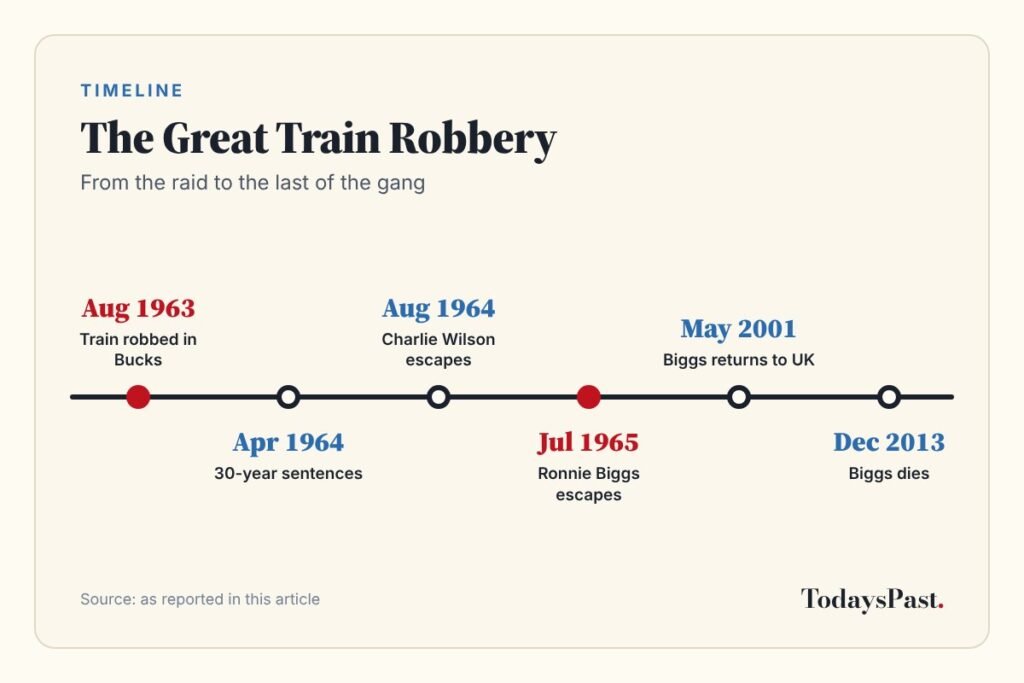
The trial opened at Aylesbury on 20 January 1964 and lasted 51 days. On 15 April 1964, most of the main robbers were sentenced to 30 years in prison, far longer than many sentences given for murder at the time. The judge, Mr Justice Edmund Davies, described the robbery as “a crime of sordid violence inspired by vast greed”.
The sentences caused controversy then and still do. Supporters said they reflected the scale of the crime and the attack on Jack Mills. Critics argued they were out of proportion.
The escapes: Charlie Wilson and Ronnie Biggs
Two of the robbers did not stay in prison for long:
- Charlie Wilson was broken out of Winson Green Prison in Birmingham in August 1964 and lived in Canada before being recaptured in 1968.
- Ronnie Biggs escaped from Wandsworth Prison in July 1965 by climbing over a wall on a rope ladder. He fled to Australia and then Brazil, where he lived openly for decades. He could not be extradited, partly because he had a Brazilian son.
Biggs became a celebrity of sorts, selling souvenirs to tourists and even recording a song with the Sex Pistols. In May 2001, in poor health, he flew back to Britain voluntarily and was arrested on arrival. He was released on compassionate grounds in 2009 and died in December 2013 (Wikipedia).
What happened to the others?
- Bruce Reynolds fled to Mexico, was arrested in Torquay in 1968 and jailed for 25 years. He later wrote a memoir and died on 28 February 2013.
- Buster Edwards lived in Mexico before returning to England in 1966. He was jailed for 15 years and later ran a flower stall outside Waterloo station. His story became the 1988 film Buster, starring Phil Collins. He died in 1994.
- Jack Mills, the train driver, never fully recovered from the attack. He suffered lasting headaches and trauma, and died of leukaemia in 1970.
Where did the money go?
Less than £400,000 of the £2.6 million was ever recovered. Some was found dumped in woods and in a phone box. Much of the rest was spent, lost to the people who helped launder it, or simply disappeared. The money was in used notes that could not easily be traced, which is exactly why the gang chose that train.
Why the Great Train Robbery still fascinates
Part of the appeal is the audacity: a small group stopping a mail train with a battery and a glove over a signal. Part is the way the robbers, especially Biggs, were turned into folk heroes by the press. But it is worth remembering that the romance came at a cost. Jack Mills was beaten, and the crime was violent, not the gentlemanly caper it is sometimes painted as.
The robbery has inspired films, books and TV dramas, including Buster (1988) and the BBC’s two-part drama The Great Train Robbery (2013). For another of Britain’s biggest heists, read our story of the Brink’s-Mat gold robbery.
Key facts
| Fact | Detail |
|---|---|
| Date | Thursday 8 August 1963, just after 3am |
| Place | Sears Crossing and Bridego Bridge, near Ledburn, Buckinghamshire |
| Train | Royal Mail travelling post office, Glasgow to London Euston |
| Stolen | About £2.6 million (around £50 million today) |
| Recovered | Less than £400,000 |
| Sentences | Most of the main robbers jailed for 30 years in April 1964 |
| Famous escapes | Charlie Wilson (1964) and Ronnie Biggs (1965) |
Frequently asked questions
How much was stolen in the Great Train Robbery?
About £2.6 million in used banknotes, worth roughly £50 million in today’s money. Less than £400,000 was ever recovered.
Where did the Great Train Robbery happen?
At Sears Crossing and Bridego Bridge, near Ledburn and Mentmore in Buckinghamshire, on the West Coast Main Line.
Was anyone hurt in the Great Train Robbery?
Yes. The train driver, Jack Mills, was struck on the head and seriously injured. He never fully recovered and died in 1970.
How did Ronnie Biggs escape?
Biggs escaped from Wandsworth Prison in July 1965 by climbing a rope ladder over the wall. He fled to Australia and then Brazil, and only returned to Britain voluntarily in 2001.
Who was the leader of the Great Train Robbery?
Bruce Reynolds is usually described as the leader and main planner, with Gordon Goody and Buster Edwards among the other organisers.
Was all the money found?
No. Most of it was never recovered. Police found less than £400,000, and what happened to the rest is still unknown.
Sources: Wikipedia: Great Train Robbery (1963); Wikipedia: Ronnie Biggs. Published for the 63rd anniversary of the robbery.