Peter Sullivan: 38 Years for a Murder He Didn’t Commit, and the Search for Diane Sindall’s Killer
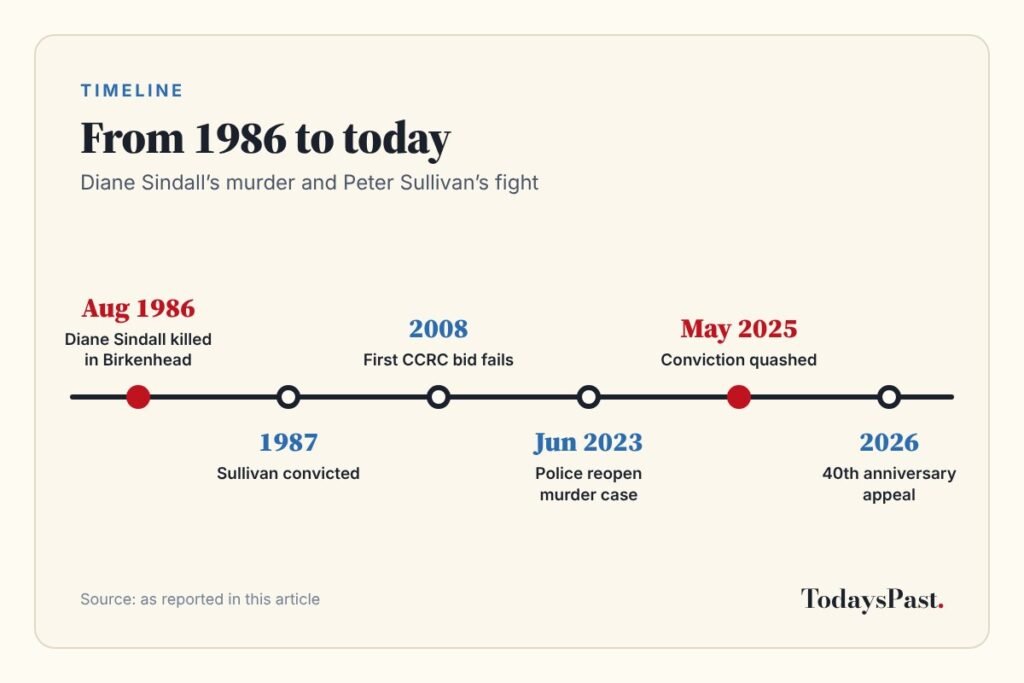
In the early hours of 2 August 1986, 21-year-old Diane Sindall was attacked and killed as she walked home through Birkenhead on Merseyside. A year later, a local man, Peter Sullivan, was convicted of her murder and jailed for life.
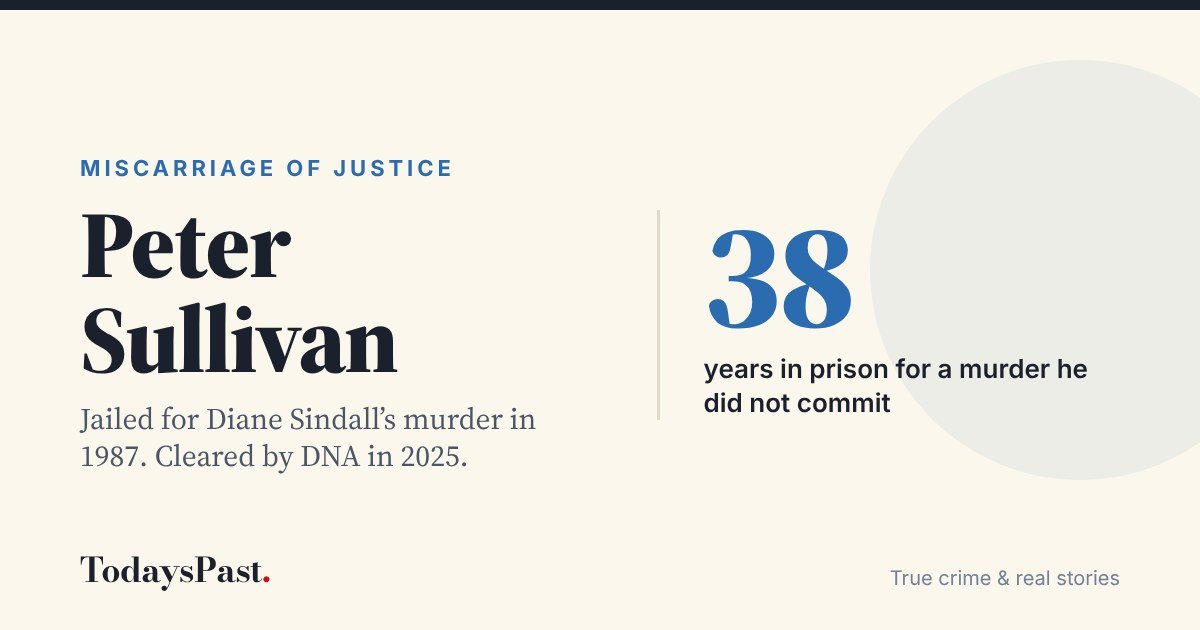
He spent the next 38 years in prison, always saying he was innocent. On 13 May 2025, the Court of Appeal quashed his conviction after new DNA testing showed that the man who attacked Diane was someone else. It is believed to be the longest-running miscarriage of justice in British legal history (ITV News).
Diane’s killer has still not been identified. This is the story of what happened, how the wrong man was convicted, and the search that is still going on 40 years later.
Who was Diane Sindall?
Diane was a 21-year-old florist who also worked part-time as a barmaid at the Wellington Hotel pub in Bebington, saving money for her wedding (Euronews). She lived in Birkenhead with her fiancé.
On the night of 1 August 1986, she finished her shift and set off to drive home. Her car ran out of petrol in Birkenhead, so she started walking along Borough Road. Witnesses saw her there shortly after midnight. Her body was found by a member of the public later that morning, in an alleyway off Borough Road (Merseyside Police appeal). She had been sexually assaulted and suffered severe injuries.
Her death caused fear and anger across Merseyside, and the investigation that followed was the largest in the history of Merseyside Police (Wikipedia).
Why was Peter Sullivan convicted?
Peter Sullivan was an unemployed labourer from Birkenhead, then in his late twenties. He was arrested on 23 September 1986, after giving conflicting accounts of where he had been on the night of the murder.
The case against him at his trial in 1987 rested on two main things:
- Confessions. Sullivan was said to have confessed during police interviews, then withdrew the admissions. He had no access to a solicitor until 25 September, two days after his arrest, because police judged that legal advice might hinder the inquiry. A psychologist later described him as suggestible, with limited intellectual ability, and no appropriate adult was present (Wikipedia).
- Bite marks. An expert told the jury that bite marks on Diane’s body matched Sullivan’s teeth. Bite-mark comparison has since been heavily criticised as unreliable around the world.
Crucially, the semen samples recovered from Diane could not be tested for DNA. The technology was in its infancy and was not available to the original inquiry. The samples were stored instead.
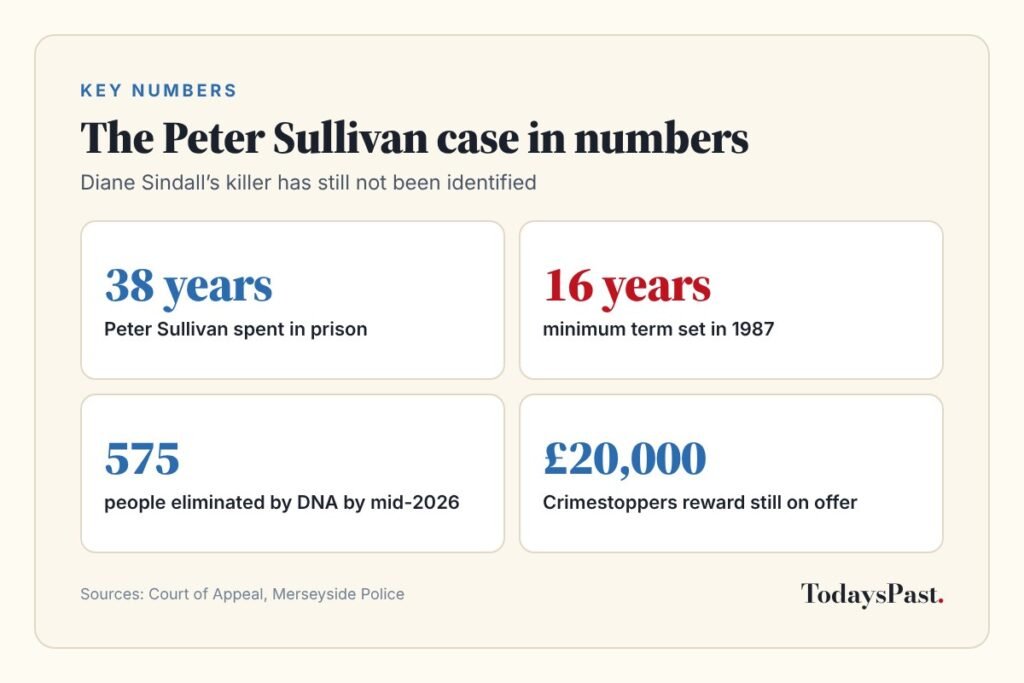
Sullivan was convicted of murder in 1987 and sentenced to life imprisonment, with a minimum term of 16 years. He maintained his innocence throughout, and stayed in prison for more than two decades beyond that minimum term.
How DNA proved Peter Sullivan was innocent
Sullivan applied to the Criminal Cases Review Commission (CCRC) in 2008, but forensic experts advised that further testing was very unlikely to produce a DNA profile, so his case was not sent back to court. A direct application to the Court of Appeal in 2019 was rejected in 2021 (CCRC).
When he applied to the CCRC again, it decided to revisit DNA testing because forensic science had moved on. This time, scientists obtained a full DNA profile from the preserved samples. It did not match Sullivan. It belonged to an unknown man.
The CCRC referred the case to the Court of Appeal in November 2024. At the hearing on 13 May 2025, the Crown Prosecution Service said the new evidence was sufficient to cast doubt on the safety of the conviction. Three judges, led by Lord Justice Holroyde, quashed it. The court made its decision on the DNA evidence alone and did not rule on the other grounds, including the bite marks and the confessions (Court of Appeal judgment). No retrial was sought.
Sullivan, then 68, watched by video link from HMP Wakefield and wept as the ruling was read out. He was released the same day.
“I am not angry, I am not bitter”
In a statement read outside court, Sullivan said he was not angry or bitter. He said what had happened to him was very wrong, but that it did not lessen the terrible loss of Diane’s life, and he apologised to her family, who now had to come to terms with her death being down to someone else (Euronews).
His sister, Kim Smith, said the family had lost Peter for 39 years, but that nobody had really won: the Sindall family had lost their daughter and would never get her back.
The hunt for Diane Sindall’s real killer
Merseyside Police reopened the murder investigation in June 2023, as soon as the CCRC told them the DNA did not match Sullivan (Merseyside Police). Detectives have been working through people connected to the original inquiry and asking them to give DNA samples, and the National Crime Agency is helping to identify the man the profile belongs to.
By the 40th anniversary of the murder in summer 2026, police said 575 people had been eliminated through DNA enquiries, with more still under review (L1 Local). The DNA does not match Diane’s family or her fiancé.
In March 2026, Diane’s family made their first public statement since the conviction was overturned, as part of a renewed appeal on BBC Crimewatch. They said her loss had been felt throughout their everyday lives, with a heartache that would never heal (ITV News).
Also in March 2026, the Independent Office for Police Conduct (IOPC) announced an independent investigation into complaints about the original 1986 police investigation of Peter Sullivan. It is separate from the murder inquiry.
A Crimestoppers reward of up to £20,000 is still on offer for information, given exclusively to the charity, that leads to the arrest and conviction of the person responsible.
If you have information, you can contact Crimestoppers anonymously on 0800 555 111 or online at crimestoppers-uk.org, or contact Merseyside Police.
Diane’s legacy
Diane’s murder led a group of local women to set up the Wirral Rape Crisis Counselling Service, which launched in 1987. Today it is RASA Merseyside, supporting survivors of sexual violence across Liverpool, Sefton and Wirral. A memorial stone stands on Borough Road in Birkenhead, near where she died.
Will Peter Sullivan get compensation?
Not automatically. Under UK law, people whose convictions are quashed can only receive government compensation if they show that a new fact proves “beyond reasonable doubt” that they did not commit the offence. Labour MP Kim Johnson, who chairs the all-party parliamentary group on miscarriages of justice, has called for an independent inquiry into Sullivan’s case (Wikipedia).
Why this case matters
- It shows the power of preserved evidence. Samples that could not be tested in 1986 eventually freed an innocent man, because they were kept.
- It raises questions about confessions from vulnerable people. Sullivan was questioned without a lawyer at first and without an appropriate adult, despite his learning difficulties.
- It shows the limits of forensic “matching”. Bite-mark evidence that helped convict him is now widely regarded as unreliable.
- It is still an open murder case. Somewhere, the man whose DNA was found may still be alive.
Key facts
| Fact | Detail |
|---|---|
| Victim | Diane Sindall, 21, florist and part-time barmaid |
| Date | Night of 1–2 August 1986, Birkenhead, Merseyside |
| Wrongly convicted | Peter Sullivan, 1987; life, minimum 16 years |
| Time in prison | 38 years |
| Conviction quashed | 13 May 2025, Court of Appeal, on new DNA evidence |
| Investigation | Reopened June 2023; 575 people eliminated by DNA by mid-2026 |
| Reward | Up to £20,000 via Crimestoppers (0800 555 111) |
Frequently asked questions
Who killed Diane Sindall?
Her killer has not been identified. DNA recovered from her body belongs to an unknown man. Merseyside Police reopened the case in 2023 and are working with the National Crime Agency to identify him.
How long was Peter Sullivan in prison?
About 38 years. He was arrested in 1986, convicted in 1987 and released on 13 May 2025, when the Court of Appeal quashed his conviction. It is believed to be the longest miscarriage of justice in UK history.
Why was Peter Sullivan convicted?
The case against him relied on disputed confessions made during police interviews and on bite-mark evidence. DNA testing was not available at the time.
How was Peter Sullivan cleared?
The Criminal Cases Review Commission arranged new DNA testing on samples kept from 1986. A full profile was obtained that did not match him, and the Court of Appeal quashed his conviction in May 2025.
Is there a reward for information about Diane Sindall’s murder?
Yes. Crimestoppers is offering up to £20,000 for information given exclusively to the charity that leads to the arrest and conviction of the person responsible. Call 0800 555 111 anonymously.
Has Peter Sullivan been compensated?
There is no automatic right to compensation. Under UK law, a person whose conviction is quashed must show beyond reasonable doubt that they did not commit the offence to qualify for government compensation.
Sources: Court of Appeal judgment, R v Sullivan [2025] EWCA Crim 772; Criminal Cases Review Commission; Merseyside Police; ITV News, May 2025; ITV News, March 2026; Merseyside Police 40th anniversary appeal; L1 Local; Wikipedia. We will update this article if there are developments in the investigation.