Intermittent Fasting Explained: Does 16:8 or 5:2 Really Work?
Intermittent fasting means eating much less, or nothing at all, at certain times of the day or week. The 16:8 method and the 5:2 diet have become two of the most popular ways to lose weight in the UK, helped by books, apps and celebrity stories.
But does it actually work better than a normal diet? Here is what the different methods involve and what the biggest review of the evidence so far has found, in plain English.
The main types of intermittent fasting
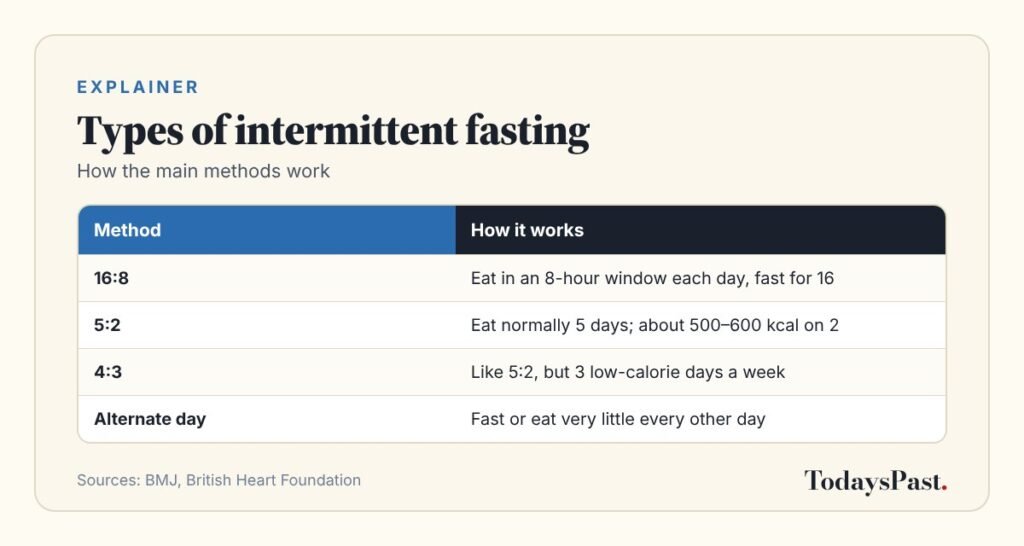
16:8 (time-restricted eating)
You eat all your food within an 8-hour window each day, for example between noon and 8pm, and fast for the other 16 hours. You do not have to count calories, although what you eat in the window still matters.
5:2 (whole-day fasting)
You eat normally for five days a week and cut right down on two non-consecutive days. On fast days, the usual guide is about a quarter of your normal intake: roughly 500 calories for women and 600 for men (British Heart Foundation). A 4:3 version uses three fast days instead of two.
Alternate-day fasting
You fast, or eat very little, every other day, and eat normally on the days in between. It is the most demanding of the three.
Does intermittent fasting work for weight loss?
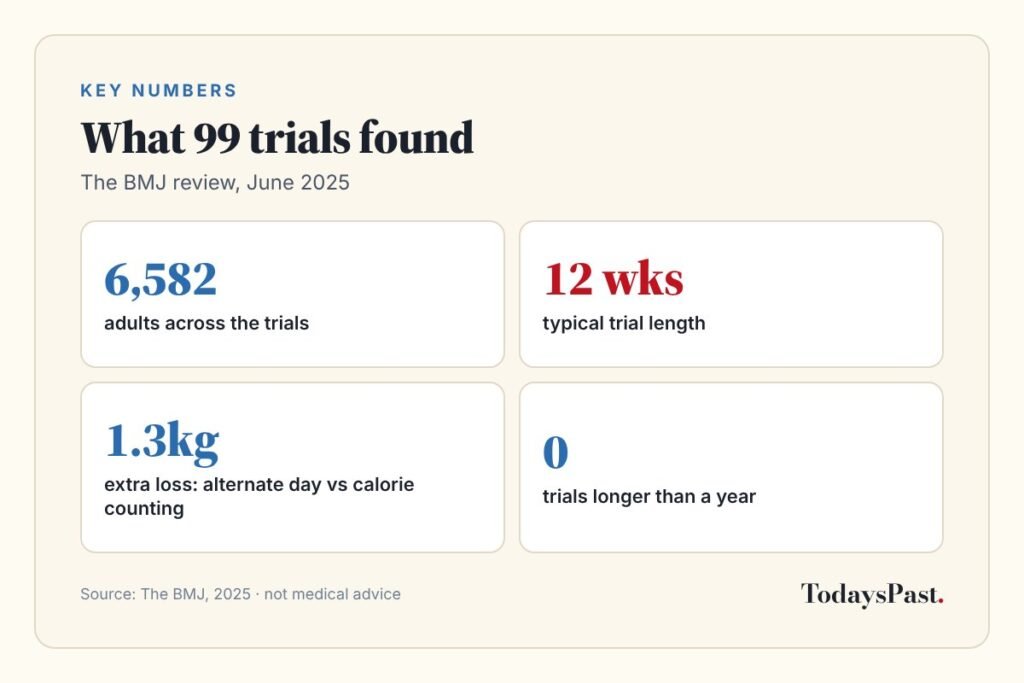
Yes, but probably not better than other ways of cutting calories. In June 2025, The BMJ published a review of 99 clinical trials involving 6,582 adults. It compared the three types of fasting with a standard calorie-controlled diet and with eating as normal (The BMJ).
- All three fasting methods, and the standard calorie-controlled diet, led to weight loss compared with eating as normal.
- The amounts were small. The authors described the improvements as “trivial to small”.
- Alternate-day fasting came out slightly ahead, with about 1.3kg more weight loss on average than a standard calorie-controlled diet.
- Trials lasted from 3 to 52 weeks, averaging 12 weeks. None lasted more than a year, so long-term effects are unknown.
An earlier UK trial of 300 adults, led by Queen Mary University of London, found much the same thing. After a year, simple 5:2 advice worked about as well as standard weight-loss advice from a GP. But people on the 5:2 diet liked it more and were more willing to stick with it (Queen Mary University of London).
So why do people say it works?
Because, for many people, it is an easier way to eat less. Fasting does not appear to burn fat by some special process. It works because skipping meals, or having two very low-calorie days, usually means eating fewer calories over the week. If you overeat on your normal days, you can cancel the deficit out (British Heart Foundation).
That means the best diet is the one you can keep up. If fasting suits your routine, it is a reasonable option. If it leaves you hungry, tired and snacking, a steady daily calorie deficit will work just as well. Our calorie deficit calculator shows how much to eat to lose weight at a safe pace, and the protein calculator helps you stay full. If you are unsure how many calories you burn in the first place, our explainer on BMR vs TDEE walks through it, and calorie deficits explained shows how to set a safe target.
Side effects and who should not fast
Some people feel hungrier, more tired or more irritable on fast days. The British Heart Foundation suggests leaving at least one normal day between fast days. It says intermittent fasting is not suitable for (BHF):
- people with diabetes or low blood sugar
- people who are underweight
- anyone with a history of eating disorders
- pregnant or breastfeeding women
- children and teenagers
If you have a health condition, or take medicines that need to be taken with food, check with your GP before you try it.
Related reading
- Calorie Deficit Explained: How to Set a Safe, Sustainable Target
- BMR vs TDEE: What’s the Difference, and Which Should You Use?
- How Many Steps a Day to Lose Weight? What the Evidence Does—and Does Not—Say
- GLP-1 Weight Loss Drugs Explained: Wegovy, Mounjaro, Ozempic and Foundayo
Frequently asked questions
Frequently asked questions
Is intermittent fasting better than a normal diet?
Not by much. A 2025 BMJ review of 99 trials found all fasting methods led to similar small weight loss to a standard calorie-controlled diet. Alternate-day fasting did slightly better, by about 1.3kg on average.
What is the 16:8 diet?
You eat within an 8-hour window each day and fast for the other 16 hours, for example eating only between noon and 8pm.
How many calories can you eat on a 5:2 fast day?
The usual guide is about a quarter of your normal intake: roughly 500 calories for women and 600 for men.
Can I drink coffee while fasting?
Most fasting plans allow water and drinks with no or very few calories, such as black coffee or plain tea. Adding milk or sugar adds calories.
Who should not try intermittent fasting?
People with diabetes or low blood sugar, people who are underweight, anyone with a history of eating disorders, pregnant or breastfeeding women, and children and teenagers. Check with your GP first if you have a health condition.
Is intermittent fasting safe long term?
We do not know yet. None of the trials in the 2025 BMJ review lasted longer than a year.
This article is general information, not medical advice. Speak to your GP or a pharmacist before making big changes to how you eat.
Sources: Semnani-Azad et al, The BMJ, 2025, BMJ press release, British Heart Foundation, Queen Mary University of London.