Scottish Income Tax 2026/27 Explained: Bands, Rates and Examples
If you live in Scotland, you pay income tax on your wages and pension at Scottish rates, not the rates used in England, Wales and Northern Ireland. Scotland has six tax bands rather than three, so the same salary can mean a slightly different tax bill depending on which side of the border you live.
Here are the 2026/27 Scottish income tax bands, how they work, and worked examples showing who pays more and who pays less.
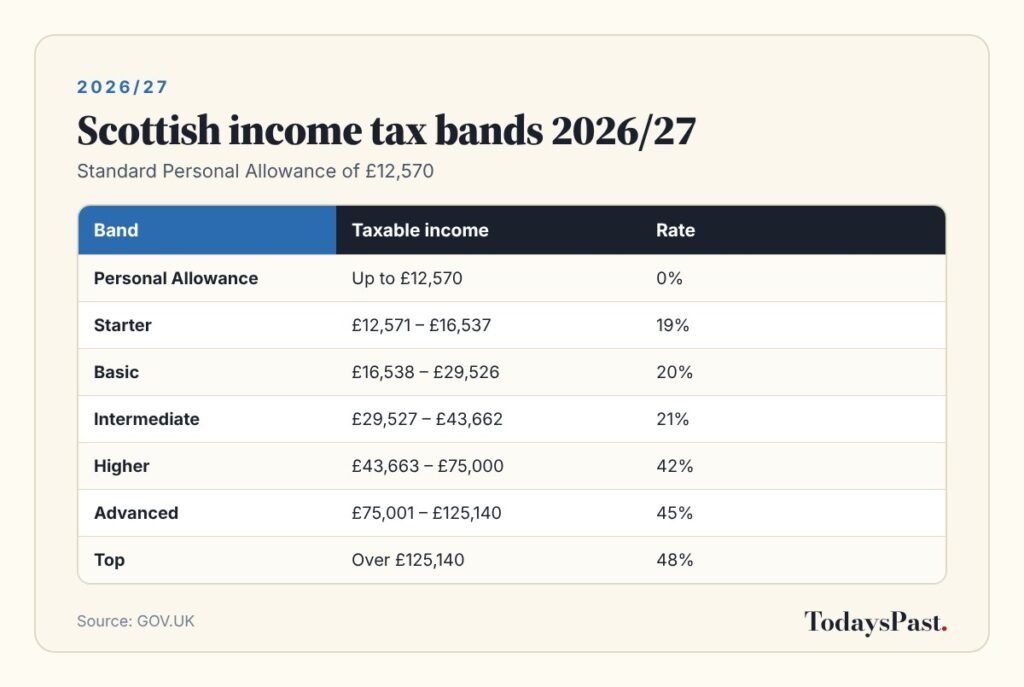
Scottish income tax bands 2026/27
These rates apply from 6 April 2026 to 5 April 2027, for anyone with the standard Personal Allowance of £12,570 (GOV.UK):
| Band | Taxable income | Rate |
|---|---|---|
| Personal Allowance | Up to £12,570 | 0% |
| Starter rate | £12,571 to £16,537 | 19% |
| Basic rate | £16,538 to £29,526 | 20% |
| Intermediate rate | £29,527 to £43,662 | 21% |
| Higher rate | £43,663 to £75,000 | 42% |
| Advanced rate | £75,001 to £125,140 | 45% |
| Top rate | Over £125,140 | 48% |
The rates themselves have not changed from last year. The Scottish Government raised the starter and basic rate thresholds, so slightly more of your income is taxed at the lower rates (Scottish Budget 2026 to 2027). If you earn over £100,000, your Personal Allowance shrinks, and you get none at all above £125,140.
How the bands work
Each rate only applies to the slice of income inside that band. Moving into a higher band does not mean all your pay is taxed at the higher rate.
Example: £30,000 salary in Scotland
- First £12,570: tax-free
- Next £3,967 at 19%: £753.73
- Next £12,989 at 20%: £2,597.80
- Last £474 at 21%: £99.54
- Total income tax: £3,451.07, or about £288 a month
Someone on the same salary in England pays £3,486, so the Scottish taxpayer pays about £35 less a year.
Do you pay more tax in Scotland?
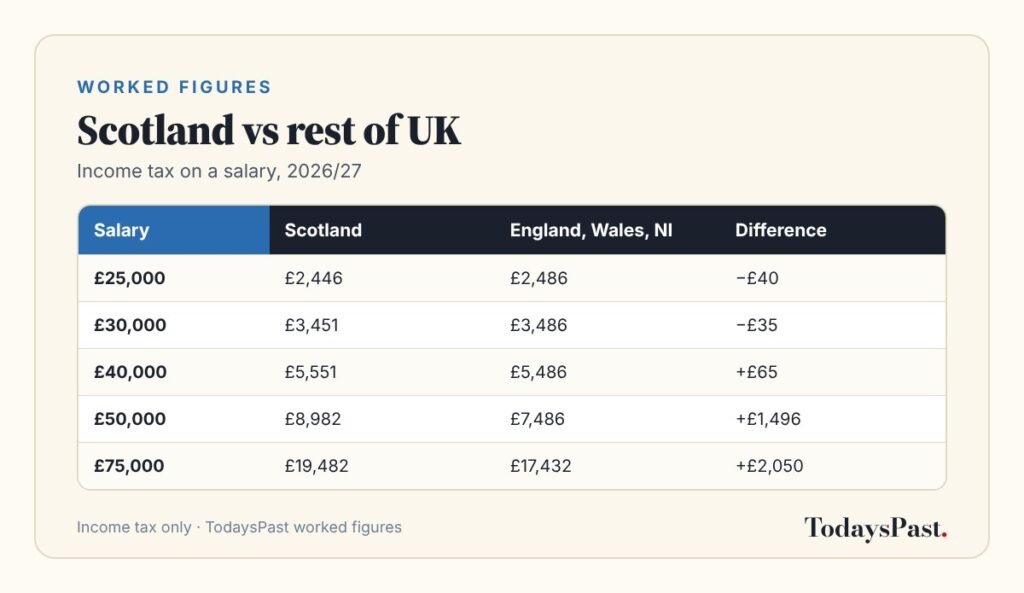
It depends on your salary. People on lower incomes pay slightly less in Scotland, because of the 19% starter rate. From about From about £33,000 upwardspound;33,500 upwards, Scottish taxpayers pay more, and the gap widens once you reach the 42% higher rate at £43,663. In England, Wales and Northern Ireland the 40% rate does not start until £50,271.
| Salary | Scotland | England, Wales and NI | Difference |
|---|---|---|---|
| £25,000 | £2,446 | £2,486 | £40 less |
| £30,000 | £3,451 | £3,486 | £35 less |
| £40,000 | £5,551 | £5,486 | £65 more |
| £50,000 | £8,982 | £7,486 | £1,496 more |
| £75,000 | £19,482 | £17,432 | £2,050 more |
| £100,000 | £30,732 | £27,432 | £3,300 more |
Figures are income tax only, for a year, with the standard Personal Allowance. They are worked out by TodaysPast.
What stays the same across the UK
- National Insurance is the same everywhere: 8% on earnings between £12,570 and £50,270, and 2% above that.
- The Personal Allowance of £12,570 is the same.
- Savings and dividend income are taxed at UK rates, even if you live in Scotland (GOV.UK).
Who counts as a Scottish taxpayer?
It depends on where you live, not where you work. If your main home is in Scotland, you pay Scottish income tax, even if you work in England. Your tax code will start with an S, for example S1257L. If you have moved to or from Scotland, tell HMRC so your tax code is updated.
To see what you take home after tax, National Insurance, pension and student loan, use our take-home pay calculator and choose the Scotland option. To work out what your salary is worth per hour, read our guide to calculating your hourly rate.
Related reading
- How to Calculate Your Hourly Rate From Your Salary (UK, 2026/27)
- NHS Take-Home Pay 2026/27 by Agenda for Change Band
- Stamp Duty in England 2026 Explained: Rates, Relief and Examples
- Compound Interest Explained: How It Works, With UK Examples
Frequently asked questions
Frequently asked questions
What are the Scottish income tax bands for 2026/27?
Starter 19% (£12,571 to £16,537), basic 20% (to £29,526), intermediate 21% (to £43,662), higher 42% (to £75,000), advanced 45% (to £125,140) and top 48% above that.
Is income tax higher in Scotland?
For people earning more than about £33,500, yes. Below that, Scottish taxpayers pay slightly less than in the rest of the UK.
How much tax do I pay on £30,000 in Scotland?
About £3,451 a year in income tax, or roughly £288 a month, plus National Insurance.
Do I pay Scottish tax if I work in England?
It depends on where you live. If your main home is in Scotland, you pay Scottish income tax wherever you work.
What does an S tax code mean?
It means HMRC treats you as a Scottish taxpayer. The usual code is S1257L.
Is National Insurance different in Scotland?
No. National Insurance rates are the same across the UK.
Sources: GOV.UK: Income Tax in Scotland, Scottish Government: rates and bands 2026 to 2027, Scottish Budget 2026 to 2027. Worked figures by TodaysPast. This is general information, not tax advice.