Best European City Breaks from the UK: 15 Ideas by Budget, Season and Travel Style
The best European city break is the one that fits your weekend, not the one with the longest attractions list. A late Friday arrival and an early Sunday flight leave little time for a sprawling city. Two full days in a compact destination can be more satisfying than rushing between landmarks somewhere larger.
This guide offers 15 ideas, with a suggested pace and a planning trade-off for each. These are editorial recommendations, not a ranking based on hotel inspections or first-hand visits. Suggested trip lengths assume full sightseeing days; add travel time separately.

Choose a city that suits your trip
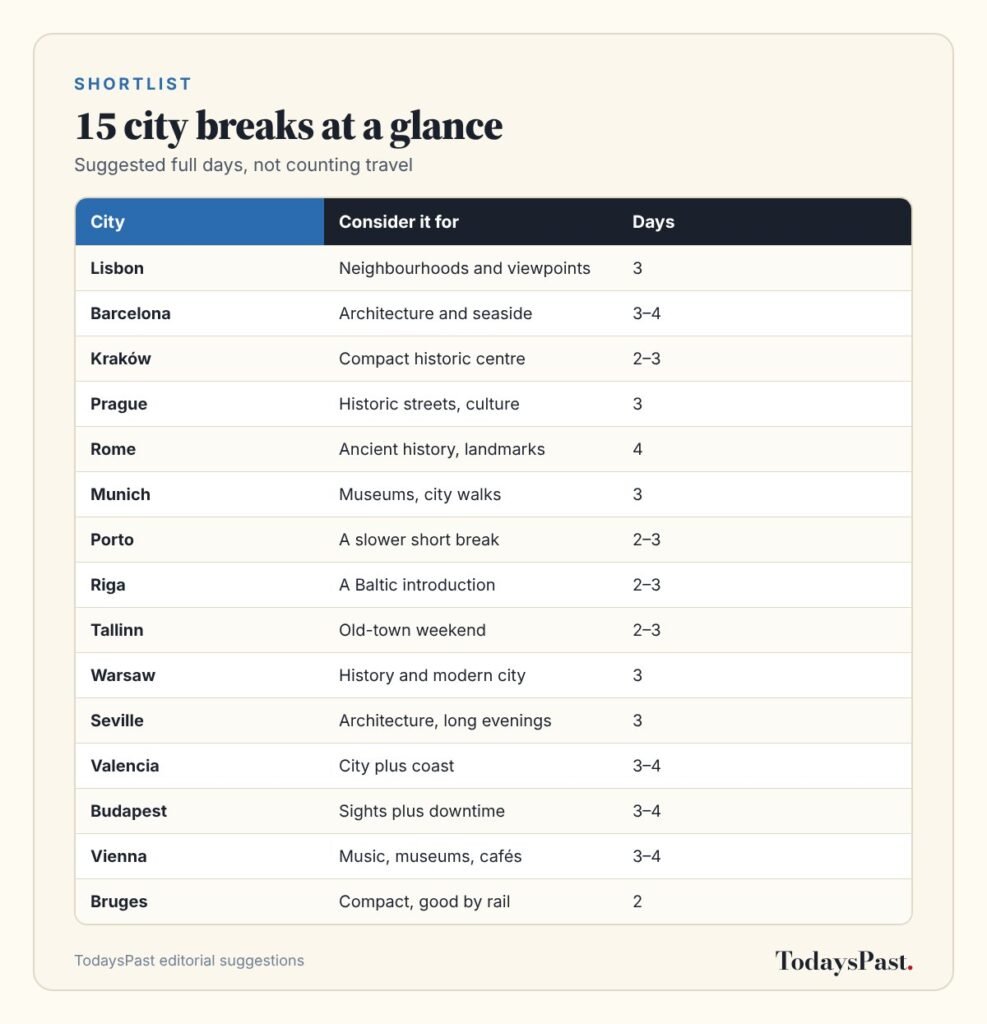
| City | Consider it for | Suggested full days |
|---|---|---|
| Lisbon | Neighbourhood walks and viewpoints | 3 |
| Barcelona | Architecture and seaside time | 3–4 |
| Kraków | A compact historic-centre break | 2–3 |
| Prague | Historic streets and cultural visits | 3 |
| Rome | Ancient history and major landmarks | 4 |
| Munich | Museums and a structured city stay | 3 |
| Porto | A slower-paced short break | 2–3 |
| Riga | A Baltic introduction | 2–3 |
| Tallinn | An old-town-focused weekend | 2–3 |
| Warsaw | History and contemporary city life | 3 |
| Seville | Architecture and unhurried evenings | 3 |
| Valencia | A city-and-coast combination | 3–4 |
| Budapest | A longer weekend with downtime | 3–4 |
| Vienna | Music, museums and cafés | 3–4 |
| Bruges | A compact break and rail-based planning | 2 |
1. Lisbon: leave room between the sights
Choose Lisbon if you want a balance of neighbourhood wandering and museum visits. Build the trip around one area at a time rather than repeatedly crossing the city. Our Lisbon city break guide has a full three-day plan. Leave an afternoon unscheduled for a café, a viewpoint or an attraction you discover along the way.
The official Visit Lisboa website lists museums, the No. 28 tram and practical transport information. It also explains Lisboa Card inclusions. Compare a card against the visits you actually intend to make rather than assuming it saves money. Allow an extra day if you want a separate excursion.
2. Barcelona: choose your architecture priorities
Barcelona suits a trip that combines architecture, neighbourhood walks and time near the sea. Plan one major booked visit per half-day, rather than making every hour depend on arriving at the next entrance on time.
Use Turisme de Barcelona for cultural listings and planning information. If your hotel is far from your main interests, compare the saving against the daily travel involved. Three or four full days is our suggested starting point, not a requirement to see every attraction.
3. Kraków: a focused historic-centre break
Kraków is a candidate for readers who want a shorter itinerary rather than an extensive checklist. Plan a central walking day and a second day for the museum or neighbourhood that interests you most.
Keep any major excursion separate from your city itinerary. Do not squeeze a memorial-site visit into an otherwise crowded sightseeing day. Use Kraków Travel to check local visitor information before choosing bookings.

4. Prague: look beyond the postcard route
Prague rewards a mix of landmark sightseeing and a quieter cultural visit. The official tourism site lists the Old Town Hall with its Astronomical Clock, the Clementinum and numerous museums, galleries and theatres. Choose according to your interests rather than trying to tick off every tower.
Our suggested three-day shape is one historic-centre day, one day across the river, and one flexible cultural day. Check the Prague City Tourism website for attraction details and current listings.
5. Rome: give the big sights enough space
Rome is our pick for travellers willing to give a landmark-heavy trip more time. Four full days allows you to separate major archaeological, religious and neighbourhood visits rather than treating the city as a single long walking route.
Book the attractions that matter most first, then arrange other plans around those times. Check Turismo Roma and the attraction’s own booking site; a reseller’s availability does not necessarily describe all ticket options.
6. Munich: make it a city trip first
Choose Munich if you prefer a stay organised around museums, urban walks and relaxed meal stops. Give the city its own time before adding distant excursions.
For a three-day visit, start with one orientation day, one museum-focused day and one flexible day. Check Munich’s official visitor website when selecting activities. Compare accommodation prices for your exact dates before committing to transport.
7. Porto: a shorter, slower alternative
Porto is a suggestion for readers who want fewer scheduled visits and more time between them. Two or three full days can work well if you resist attaching an ambitious day trip to an already short stay.
Choose your base with the journeys you will actually make in mind. Check the location, approach and accessibility of accommodation, not just its distance on a map. Use Visit Porto for visitor planning.
8. Riga: start a Baltic shortlist here
Riga is worth comparing if you want a different option from the usual western European weekend shortlist. A manageable plan would pair a central walking day with a cultural day and leave a third day flexible.
The European Travel Commission includes Riga in its Baltic travel inspiration. Use Live Riga for detailed local planning. Compare the whole trip cost rather than assuming a destination will be inexpensive because of its region.
9. Tallinn: keep the weekend compact
Consider Tallinn for an old-town-focused break with a modest daily schedule. Give yourself time to explore rather than turning a short stay into a multi-country trip.
For two full days, choose one central walking day and one day around a personal interest. Check Visit Tallinn before making attraction or transport plans, particularly for winter visits.
10. Warsaw: choose a theme
Warsaw is a good candidate for a trip built around history, architecture or contemporary culture rather than a single postcard view. Choosing a theme makes it easier to decide what to leave out.
Allow three full days as an editorial starting point. Use Warsaw’s official tourism website to build a geographically sensible itinerary and check opening days before allocating museum visits.
11. Seville: protect some unscheduled time
Choose Seville for an architecture-focused break with long pauses rather than a packed programme. Plan any priority ticketed visits first, then leave space for meals and neighbourhood walks.
Compare the seasonal forecast before booking, especially if heat affects your comfort. The official Seville tourism website is a starting point for attractions and local planning. Three full days is our suggested pace.
12. Valencia: balance city and coast
Valencia is an option when your group wants both sightseeing and some coastal downtime. Avoid pretending that a short beach stop and a full museum programme fit effortlessly into the same day.
Give each part its own time and check the travel between your hotel and your priorities. Use Visit Valencia to choose visits and transport. Our suggestion is three or four full days for a mixed itinerary.
13. Budapest: do not fill every evening
Budapest suits a longer-weekend plan that includes both sightseeing and deliberate downtime. Choose a few priorities and leave an afternoon free instead of booking back-to-back activities.
Before paying for any bathing or wellness experience, check the venue’s current rules, facilities and suitability for your group. Consult Budapest’s official tourism website for local information.
14. Vienna: choose music and museums selectively
Vienna is a natural shortlist choice for a culture-led break. The European Travel Commission highlights its musical heritage, including opportunities to plan a visit around performances.
Choose one or two cultural priorities and book them before filling the rest of the day. A performance night does not also need a late dinner reservation and an early start. Use Vienna’s official visitor guide for planning.
15. Bruges: make the journey part of the decision
Bruges suits a compact historic-centre itinerary. European Travel Commission guides highlight its Markt, canals and Belfort. Two full days is our suggested starting point for an unhurried first visit.
If travelling by rail, compare the full connection from your UK starting point, not just one international segment. Check Visit Bruges for local visitor information and your rail operator for the actual journey.
Compare budgets without misleading price tags
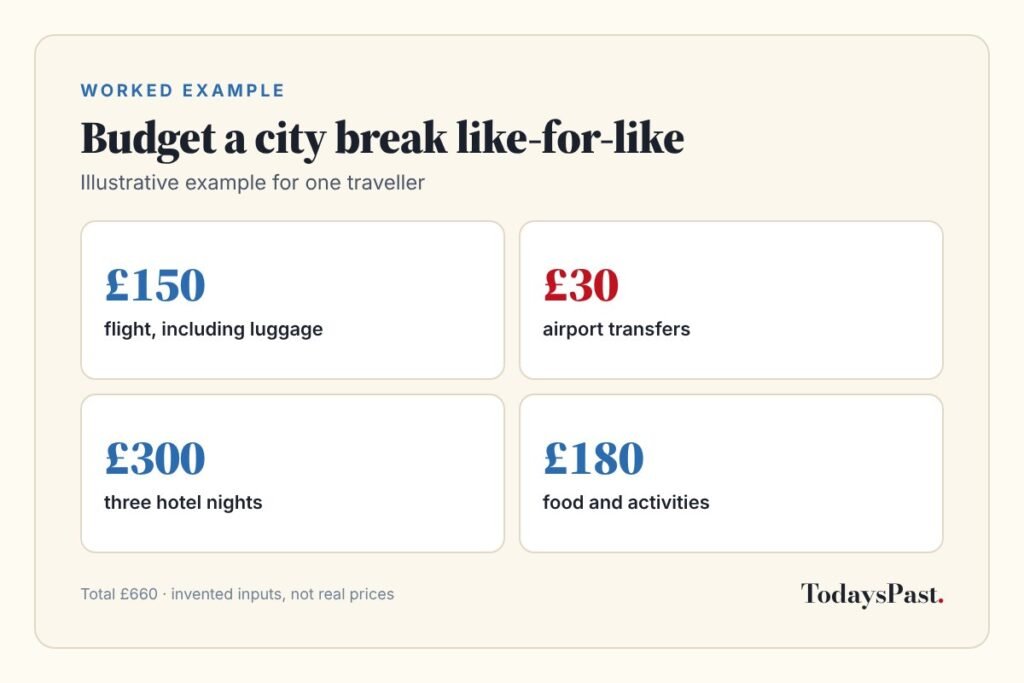
A city is not automatically cheap or expensive for your dates. Build a like-for-like quote for each option: transport including luggage, return airport or station transfers, accommodation for every night, local travel, meals and your priority attractions.
As an illustration only, a £150 flight, £30 transfer, three £100 hotel nights, £120 food allowance and £60 activities total £660 for one traveller. These are invented budgeting inputs, not current destination prices. Sharing a room changes the per-person accommodation cost; it does not halve the entire trip.
Pick a season for what you want to do
For a walking-heavy trip, compare temperatures and daylight rather than simply chasing the lowest fare. For a museum-led winter break, verify opening days. If travelling for a seasonal event, check its official dates before paying for non-refundable transport.
Summer is not a guarantee of suitable beach weather, and a winter city break is not a guarantee of snow. Keep one indoor alternative and enough flexibility to swap days.
Before booking from the UK
- Count usable hours, not just nights. An evening arrival and morning departure may leave only one full day.
- Check the exact arrival airport and transfer options before choosing a fare.
- Check passport, entry and travel requirements for your nationality and destination using FCDO country advice and the relevant authorities.
- Compare insurance cover with your activities and circumstances.
- Check accessibility: a compact old town is not necessarily step-free or easy with luggage.
Related reading
- Lisbon City Break: A Practical Guide for First-Time Visitors
- Scotland Road Trips: 7 Scenic Routes, Itineraries and Planning Tips
- Cornwall Road Trip: A Practical 5-Day Coastal Itinerary
Frequently asked questions
Which city should I choose for a first European city break?
Start with the easiest journey from your departure point and your main interest. Our shortlist suggestions are Lisbon for neighbourhood exploration, Prague for historic streets, and Bruges for a compact visit. None is the best option for every traveller.
Is a two-night break enough?
It can be, if the transport times leave you enough usable time. Check the full door-to-door journey before deciding that a destination fits a weekend.
Are city passes worth buying?
Only when the included visits and transport match your actual plans. Compare individual tickets and reservation requirements; do not add attractions merely to justify a pass.
Should I book transport or accommodation first?
Check both together before paying for either. A low fare is not a bargain if suitable accommodation is unavailable or the return transfer is impractical.
Trip lengths and recommendations are editorial suggestions. No live fares, hotel quotes or route availability are claimed. Verify prices, opening times and travel requirements before booking.